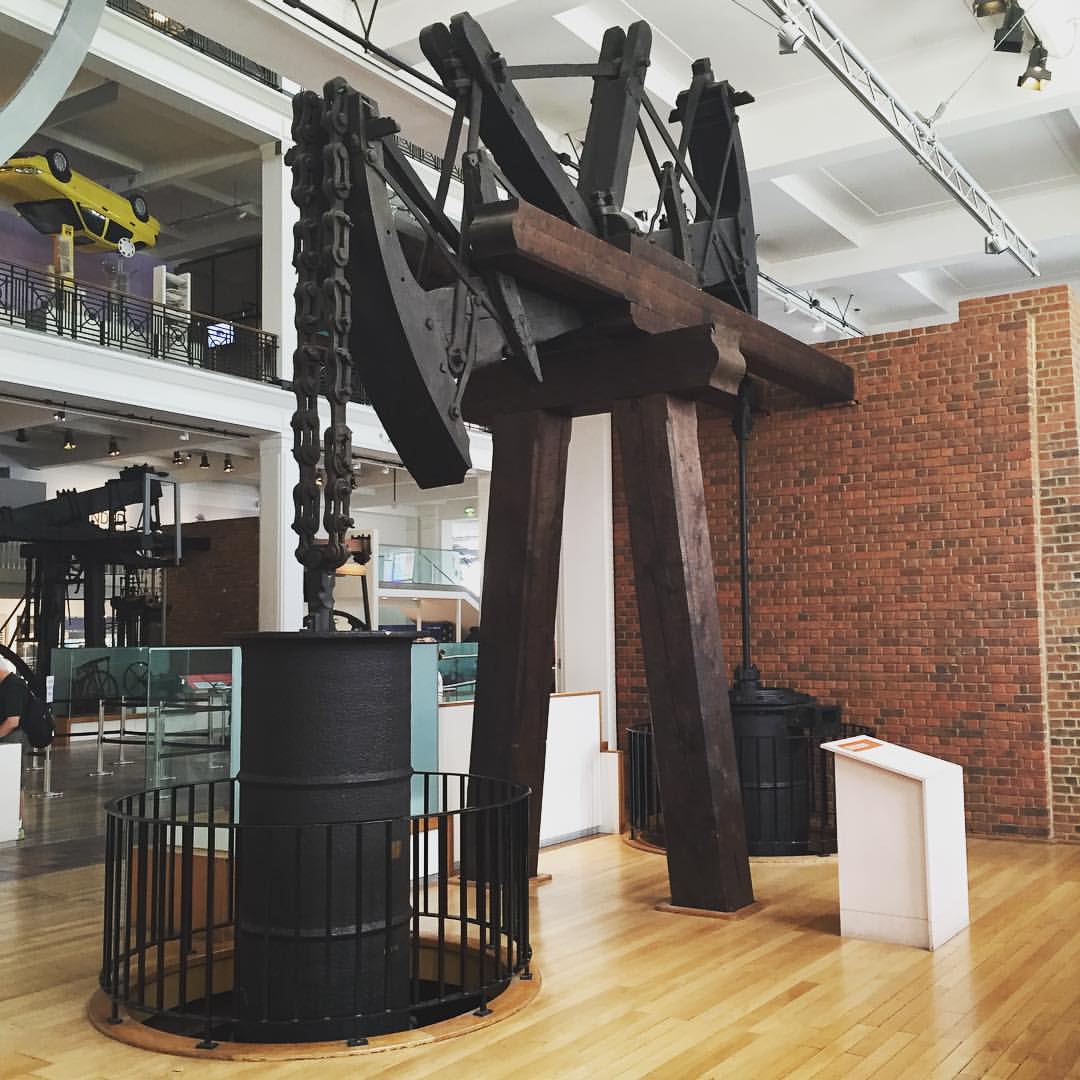
Jekyll2024-10-24T07:25:44-07:00https://blog.rootsofprogress.org/feed/articles.xmlThe Roots of Progress | ArticlesA new philosophy of progress for the 21st centuryBig tech transitions are slow2024-10-24T07:12:00-07:002024-10-24T07:12:00-07:00https://blog.rootsofprogress.org/big-tech-transitions-are-slowThe first practical steam engine was built by Thomas Newcomen in 1712. It was used to pump water out of mines.
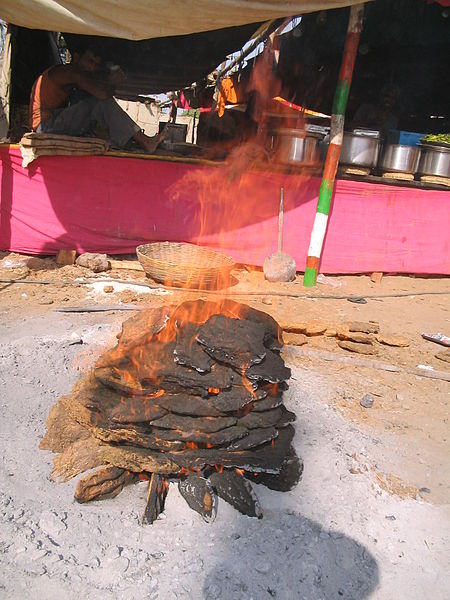
“Old Bess,” London Science Museum
Photo by the author
An astute observer might have looked at this and said: “It’s clear where this is going. The engine will power everything: factories, ships, carriages. Horses will become obsolete!”
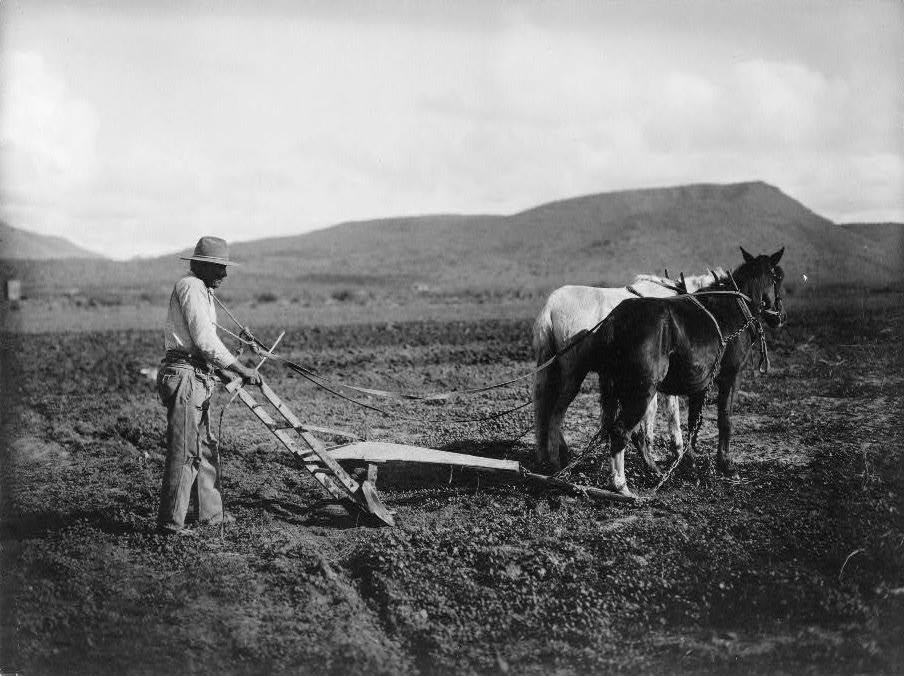
This person would have been right—but they might have been surprised to find, two hundred years later, that we were still using horses to plow fields.
In fact, it took about a hundred years for engines to be used for transportation, in steamships and locomotives, both invented in the early 1800s. It took more than fifty years just for engines to be widely used in factories.
What happened? Many factors, including:
The capabilities of the engines needed to be improved. The Newcomen engine created reciprocal (back-and-forth) motion, which was good for pumping but not for turning (e.g., grindstones or sawmills). In fact, in the early days, the best way to use a steam engine to run a factory was to have it pump water upsteam in order to add flow to a water wheel! Improvements from inventors like James Watt allowed steam engines to generate smooth rotary motion.
Efficiency was low. Newcomen engines used an enormous amount of still-relatively-expensive energy, for the work they generated, so they could only be profitably used where energy was cheap (e.g., at coal mines!) and where the work was high-value. Watt engines were much more efficient owing mainly to the separate condenser. Later engines improved the efficiency even more.
Steam engines were heavy. The first engines were therefore stationary; a Newcomen engine might be housed in a small shed. Even Watt’s engine was too heavy for a locomotive. High-pressure technology was needed to shrink the engine to the point where it could propel itself on a vehicle.
Better fuels were needed. Steam engines consumed dirty coal, which belched black smoke, often full of nasty contaminants like sulfur. Coal is a solid fuel, meaning it has to be transported in bins and shoveled into the firebox. In the late 1800s, more than 150 years after Newcomen, the oil industry began, creating a refined liquid fuel that could be pumped instead of shoveled and that gave off much less pollution.
Ultimately, a fundamental platform shift was required. Steam engines never became light enough for widespread adoption on farms, where heavy machinery would damage the soil. The powered farm tractor only took off with the invention of the internal combustion engine in the early 20th century, which had a superior power-to-weight ratio.
Not only did the transition take a long time, it produced counterintuitive effects. At first, the use of draft horses did not decline: it increased. Railroads provide long-haul transportation, but not the last mile to farms and houses, so while they substitute for some usage of horses, they are complementary to much of it. An agricultural census from 1860 commented on the “extraordinary increase in the number of horses,” noting that paradoxically “railroads tend to increase their number and value.” A similar story has been told about how computers, at first, increased the demand for paper.
Engines are not the only case of a relatively slow transition. Electric motors, for instance, were invented in the late 1800s, but didn’t transform factory production until about fifty years later. Part of the reason was that to take advantage of electricity, you can’t just substitute a big central electric motor in place of a steam or gas engine. Instead, you need to redesign the entire factory and all the equipment in it to use a decentralized set of motors, one powering each machine. Then you need to take advantage of that to change the factory layout: instead of lining up machines along a central power shaft as in the old system, you can now reorganize them for efficiency according to the flow of materials and work.
All of these transitions may have been inevitable, given the laws of physics and economics, but they took decades or centuries from the first practical invention to fully obsoleting older technologies. The initial models have to be improved in power, efficiency, and reliability; they start out suitable for some use cases and only later are adapted to others; they force entire systems to be redesigned to accommodate them.
At Progress Conference 2024 last weekend, Tyler Cowen and Dwarkesh Patel discussed AI timelines, and Tyler seemed to think that AI would eventually lead to large gains in productivity and growth, but that it would take longer than most people in AI are anticipating, with only modest gains in the next few years. The history of other transitions makes me think he is right. I think we already see the pattern fitting: AI is great for some use cases (coding assistant, image generator) and not yet suitable for others, especially where reliability is critical. It is still being adapted to reference external data sources or to use tools such as the browser. It still has little memory and scant ability to plan or to fact-check. All of these things will come with time, and most if not all of them are being actively worked on, but they will make the transition gradual and “jagged.” As Dario Amodei suggested recently, AI will be limited by physical reality, the need for data, the intrinsic complexity of certain problems, and social constraints. Not everything has the same “marginal returns to intelligence.”
I expect AI to drive a lot of growth. I even believe in the possibility of it inaugurating the next era of humanity, an “intelligence age” to follow the stone age, agricultural age, and industrial age. Economic growth in the stone age was measured in basis points; in the agricultural age, fractions of a percent; in the industrial age, single-digit percentage points—so sustained double-digit growth in the intelligence age seems not-crazy. But also, all of those transitions took a long time. True, they were faster each time, following the general pattern that progress accelerates. But agriculture took thousands of years to spread, and industry (as described above) took centuries. My guess is the intelligence transition will take decades.
The per-capita GDP of Canada has increased about thirty-fold over the last two centuries, from $1,441 in 1820 to $45,530 in 2022 (adjusted for inflation).1 This is an enormous increase. Are Canadians enormously better off?
That is, we’ve been assuming so far that material benefits improve human well-being. Do they? And if not, what’s the point of material progress?
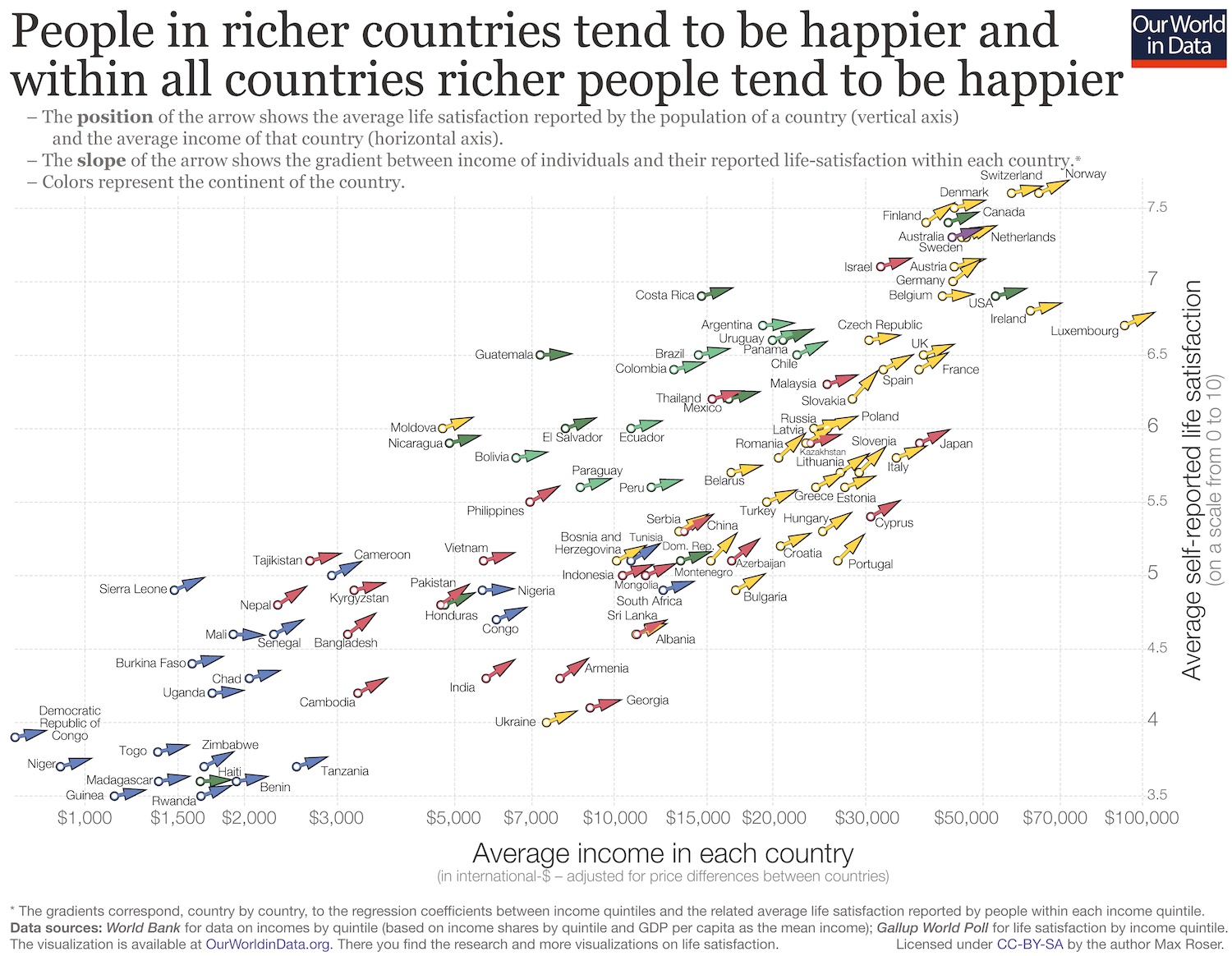
We might think, to start, that to measure well-being we could survey people about their happiness or life satisfaction.2 Psychologists and economists have been doing this kind of research for decades. At any point in time, happiness scores are positively correlated with income, both between and within countries: richer countries are happier, and within each country, richer people are happier:3
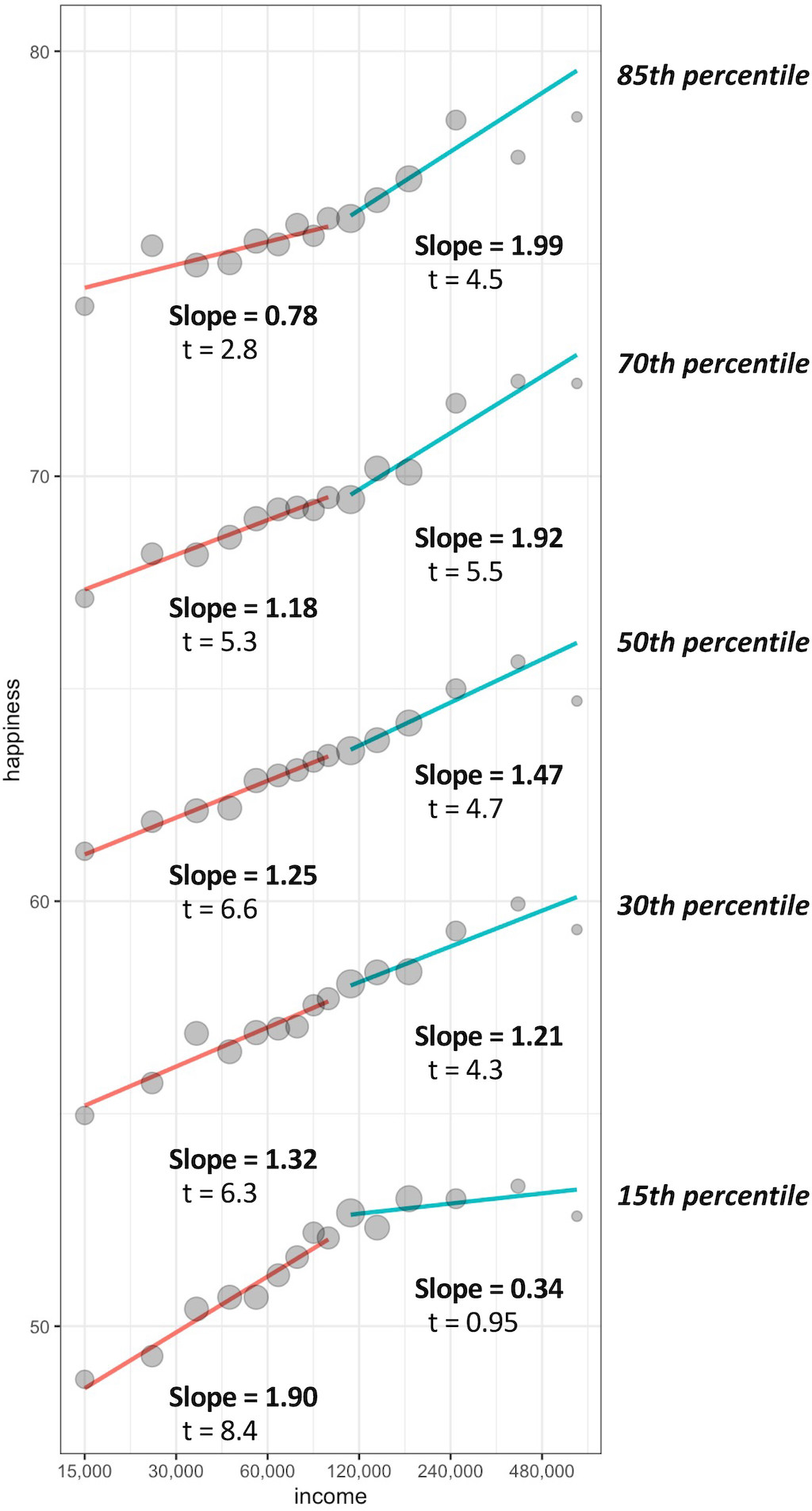
You may have heard that this effect levels off after a certain threshold of income—in the popular consciousness, around $75,000—and that beyond this, more money doesn’t make people happier. This was based on a study from 2010,4 but later research found that this was only true for the unhappiest people.5 That is, if you are deeply unhappy, more money past a certain point (somewhere between $60k and $90k, in 2010 dollars) won’t improve your happiness much. But most people continue to get happier with more income, with no limit that has been measured. In fact, the happiness of the happiest people seems to accelerate at higher levels of wealth:
Emotional well-being vs. income, for five different percentiles of the happiness distribution (Killingsworth 2023)
Emotional well-being vs. income, for five different percentiles of the happiness distribution.
Killingsworth 2023
(Note that happiness scores are proportional to the logarithm of income; in the charts above, the x-axis is on a log scale. An intuitive way to understand this is that a 10% raise will make you equally happy no matter whether you are starting from a salary of $30k or $300k.)
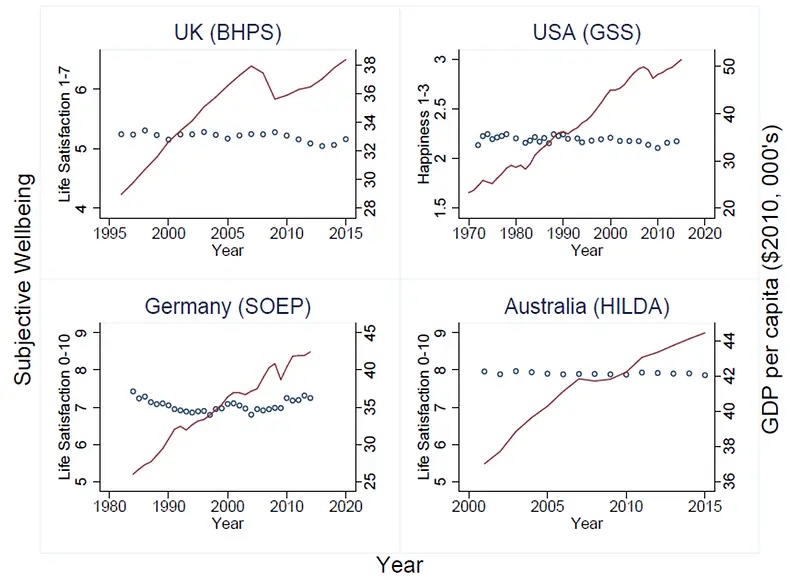
Comparisons over time, however, are muddier. While in many countries, happiness increases over time as the economy grows, in some it stays flat or decreases. Over the longest time spans we have data for, the correlation between economic growth and increases in happiness is weak to nonexistent. In the charts below for four wealthy countries, GDP per capita is plotted by the red line and keeps going up, while measures of subjective well-being are indicated by blue circles and are flat:6
Scholars continue to debate the right interpretation of this data,7 but for the sake of argument, let’s assume it’s true that economic growth doesn’t make people happier. Why would this be?
One explanation is that happiness is not absolute but relative. For one, it is relative to the recent past: someone with wealth and fame will still feel dejected when a beloved dog dies, and someone who is lonely and poor will still feel happy about landing even an entry-level job, despite the first person being more well-off than the second overall. In many cases, when people experience a major life event such as getting married, being laid off, or having a child, their mood resets after a time to the previous baseline, a phenomenon known as “hedonic adaptation.”8
Happiness is also relative to our expectations: if we expect to earn a bonus, or have plans to visit a good friend, and then it doesn’t happen, we’re disappointed, even though our objective situation hasn’t changed. In 1997, I had not yet graduated school or gotten married, and I was still living in my parents’ basement, but I felt that my life was going well—because I was 17. If that was still my situation today, in my mid-40s, I would no longer say that my life was going well. Expectations of growth and progress are built into our life assessments.
But some have interpreted this to mean that we are stuck on a “hedonic treadmill,” in which each advance becomes the new normal, taken for granted. The logical conclusion is that material progress can’t help the human condition. A report from the Happier Lives Institute states:
To put it bluntly, we are basically naked apes and have evolved to survive without needing many material belongings. As we’ve gone from having iPhone 5s to iPhone 6s, to iPhone 7s, to iPhone 8s and so on, these have not made a lasting improvement to our wellbeing because we just quickly get used to them. I know economists will find this conclusion almost heretical, but so much the worse for economics.9
My conclusion is the opposite: so much the worse for psychology, or more specifically, for making psychology the primary basis for our concept of human well-being.
A concept of well-being should be a guide—both in living our personal lives and in evaluating a society. It should indicate something substantive, and it should help us discover how to build well-being over time. Happiness, as understood in the research just discussed, is too subjective and relative for this purpose. What happiness surveys measure is closer to the first derivative of well-being than to its absolute level, telling us only the direction and magnitude of recent changes. If we take these surveys as our measure of value, then not only would we have to conclude that having better iPhones doesn’t matter to a society, but also that getting married, being laid off, or having a child doesn’t matter to an individual.10 Counterintuitively, happiness is not a good metric of human well-being.11
A better guide to well-being and human progress is whether people can achieve their goals and fulfill their values.12The good life is one of constantly discovering, pursuing, achieving, and maintaining values.
“Value” is a broad term; moral philosopher Valerie Tiberius says the concept can include “projects, activities, relationships, and ideals.”13 Values can range from specific, tangible goals, such as a new car, to abstract ones that are maintained over the long term, such as a marriage, or even qualities of character in ourselves such as honesty. Values are what motivate us and guide our choices over a lifetime.
The conception of well-being as value-fulfillment is solid enough to ground us in reality, but rich enough to point us towards a life that is about far more than simply staying fed, clothed, sheltered, and alive. Yes, we pursue health, longevity, and comfort—values which are directly provided by material progress. But we also seek meaning and personal fulfillment: a career that uses our talents and does good in the world; loving relationships with friends and family; the enjoyment of art and music; an understanding of our place in the universe. And we seek self-actualization: the full exercise of our skills and abilities, regardless of whether this is needed for any practical end.
That last is worth emphasizing, because of how clearly it refutes the concept of humans as primarily seeking ease and comfort. On the contrary, we get bored and restless with nothing to do. We seek challenge, adventure, knowledge, and play. When the needs of physical survival don’t provide enough of that, we invent it for ourselves: games and sports, travel, storytelling, math and science. We run races, climb mountains, compose ballads, and peer through telescopes—not for survival or comfort, but to be fully human and fully alive.
I saw this clearly after my daughter was born. If ease and comfort were the goal of life, then as an infant, she was already at the pinnacle, with nowhere left to go. She had servants to feed, clothe, and bathe her, to carry her from room to room, to soothe her to sleep, even to wipe her bottom; her slightest whim or discomfort was attended to quickly if she but made it known. But she wasn’t content with this: she wanted to explore, to satisfy her curiosity, to test and expand her powers. She was given bright, shiny toys and a clean, white mat to play on—but she wanted to crawl beyond the mat, to the strange, messy world of grown-up things: to touch the carpet and the curtains, to crawl behind and underneath the chair, to handle a grown-up cup, to pull clothes out of the drawer, to grab at hair and glasses and clothing, to eat the tag hanging underneath the sofa. She would climb over cushions, or up a foam-block incline, or up my chest, apparently for the fun of doing so; she was exhilarated by the experience of sitting upright, and later of standing. She was constantly seeking novel experiences and self-actualization.
Focusing on value-fulfillment, rather than on feelings or mood, grounds us in reality. Compared to emotion, values and their achievement are objective. They are not relative, but absolute: we can have more of them. And rather than being stuck on a treadmill, we can accumulate them without limit. Indeed, if there is one lesson to be learned from the relative nature of happiness, it is that a good life is one of growth, of constant achievement, of upward motion—a dynamic life, not a static one.
If well-being is value-fulfillment, then to improve our lives we need both to choose good values and to get them.
Technology and wealth, for all their benefits, cannot choose your values for you. They can help in this process by giving you information, but the final choice is yours. It’s up to you to define the meaning of your own life and to choose a set of values that are healthy and form a coherent whole. To guide these choices is not the job of technology, but of moral philosophy.
What technology and wealth can do is empower us to pursue the goals we have chosen. When we view material progress this way, it is something much grander than a generator of comfort and leisure: it is the great liberator allowing us to pursue rich, full lives.
First, we have the chance to actually live those lives. Historically, only about half of newborn babies would even get to enjoy a full childhood, let alone adult life.14 As late as 1851, in England and Wales, a newborn had only about a two-thirds chance to make it to adulthood, and less than 40% to live to age 60. Today, over 95% of those newborns will live to age 60.15 Even having a full adult life was once a lucky break; now it’s practically a birthright.
And more of that life can be devoted to the things we enjoy most—recreation, loved ones, personal enrichment, self-actualization—because less and less of it is devoted to basic necessities. At the start of the 20th century, the average American household devoted the vast majority of its expenditure, about 80%, just to food, clothing, and housing; by the end of the century, that was down to 50%.16 More wealth doesn’t just mean more of the same stuff, and it doesn’t even just mean more luxurious versions of the same stuff: it means that once you have fed, clothed, and housed yourself, you still have money left for dancing lessons, camping gear, a family photo session, or a trip to Taipei.
At the same time that incomes have been rising, working hours have been falling, from 60–70 hours a week in 1870 to 35–40 by 2000.17 In other words, as real wages increase, we “consume” part of that income in the form of increased leisure. This is getting time back for ourselves to spend on what we care about most, and time saved is life gained.18 Not only have working hours decreased, the work week is shorter (a two-day weekend is now standard), and we get more vacations and holidays as well (four weeks a year in the US, up from one week a year in 1900).19
And the greatest gains in leisure have gone to those who need it most: the old, and the young. The old now get to enjoy retirement, which was unknown before the 20th century.20 The previous norm was to work until incapacity or death: in 1880, 78% of 65-year-old men were still working.21 Now most of those over 65 can devote full time to hobbies, travel, or grandchildren. And retirement has effectively gotten longer as life expectancy has increased: someone retiring at age 60 in 1920 could expect to enjoy fifteen more years; by 2013 another nine years had been added to that.22 Between this and the shorter work week, a 20-year-old man today can expect to spend only 23% of his remaining hours working, whereas in 1931 that was closer to 39% (and evidence suggests that it was even higher in the late 1800s).23 Increases in leisure have given us back a sixth or more of our lives.
As for children, they no longer have to work either—as they did through most of history, whether a bucolic life on farms or harder, more dangerous work in mines and early factories. And when children don’t have to work, they can go to school. One of the noblest consequences of material progress over the last few centuries is more education. As late as 1910 in the US, the high school graduation rate was only 9%; by 2012 it was 80%.24 Worldwide, literacy rates have increased from 12% in 1820 to over 87% today.25 A more educated mind is one more ready to take on engaging and high-paying work, to appreciate the accomplishments of culture, and to participate in civic society.
Consider also domestic life. The home was completely transformed in the 20th century by plumbing, gas, and electricity; by appliances such as the washing machine, vacuum cleaner, refrigerator, and dishwasher; and by consumer goods such as pre-made clothing and packaged foods.26 Before, keeping house was a full-time job: hauling buckets of water from the well, making every meal from scratch, sewing shirts and dresses. “Laundry day” was literally an entire day of the week. The 20th-century home didn’t just increase comfort: it helped to liberate women from their role in domestic service—whether the unmarried ones who left service jobs for higher-paying and more independent jobs in industry, or the housewives who did this work without pay and often without recognition.27 Women’s workforce participation increased from 23% in 1910 to 60% by the end of the century.28
Material progress doesn’t just give us luxury, comfort, and leisure. It moves us up a hierarchy of values, freeing up money, time and energy spent on the basics and letting us redistribute them towards the fulfillment of a richer life.
We have no way to directly measure human well-being. GDP does not measure it. Life expectancy, child mortality, energy consumption, even literacy rates do not measure it. It is not the same as having plumbing, electricity, motor transportation, or internet service. It is not equivalent to reductions in disease, pollution, or malnourishment. But all of these things empower us to achieve it. And when all of these measures are moving in the right direction, we can be confident that human well-being is, too.
For more about The Techno-Humanist Manifesto, including the table of contents, see the announcement. For full citations, see the bibliography.
These figures are given in international dollars at 2011 prices: “GDP Per Capita, 2022.” ↩
The difference between these terms is subtle, but in general “happiness” refers more to an emotion and “life satisfaction” more to a cognitive evaluation. Some papers combine the two without making much of a distinction, and I won’t be making a sharp distinction here. ↩
Our World in Data sides with Stevenson and Wolfers (2008) who claim that the paradox goes away with better analysis of data; Happier Lives Institute favors Easterlin and O’Connor (2022) who say that it remains if you look over long enough time periods. ↩
Because of these limitations, the field of ethics debates a wide variety of theories of well-being, not just ones defined entirely by subjective experience. For a survey, see Eden Lin, “Well-Being, Part 2: Theories of Well-Being” in Philosophy Compass↩
For an academic treatment of this concept, see Tiberius, Well-Being as Value Fulfillment. For an influential popular account, see Rand, The Virtue of Selfishness, particularly “The Objectivist Ethics.” ↩
Tiberius, Well-Being as Value Fulfillment, 11. Rand gives a concise definition: “‘Value’ is that which one acts to gain and/or keep” (Virtue of Selfishness, 15). ↩
These figures are from Nick Crafts, “The 15-hour Work Week.” An earlier, working draft of this paper (2021) gave estimates going back to 1881, at which point the figure was about 50%. However, this was based on data from Johnson (1994), which may have problems of interpretation and not be comparable to the data from 1931 on. ↩
Gordon, Rise and Fall, 71–76, 85–88, 113, 121–125. ↩
Schwarz, More Work for Mother, 22–23, 64, 165–167, 188–191. Note, a major theme of this book is that the liberation did not happen right away, nor was home technology the direct and sole cause. At first, the result was to increase standards of domestic cleanliness, without reducing the burden on housewives: “more work for mother.” But the new technological home was a catalyst for a social movement that eventually redefined women’s role in society. ↩
]]>Jason CrawfordHow to choose what to work on2024-09-18T13:37:00-07:002024-09-18T13:37:00-07:00https://blog.rootsofprogress.org/how-to-choose-what-to-work-onSo you want to advance human progress. And you’re wondering, what should you, personally, do? Say you have talent, ambition, and drive—how do you choose a project or career?
There are a few frameworks for making this decision. Recently, though, I’ve started to see pitfalls with some of them, and I have a new variation to suggest.
Passion, competence, need
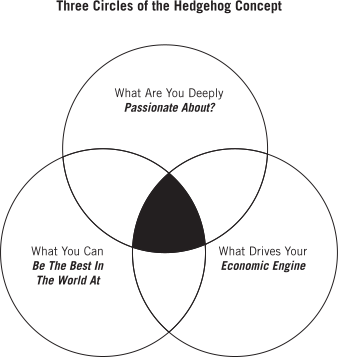
In Good to Great, Jim Collins says that great companies choose something to focus on at the intersection of:
This maps naturally onto an individual life/career, if we understand “drives your economic engine” to mean something there is a market need for, that you can make a living at.
You can understand this model by seeing the failure modes if you have only two out of three:
If you can’t be best in the world at it, then you’re just an amateur
If you can’t make a living at it, then it’s just a hobby
If you’re not passionate about it, then why bother?
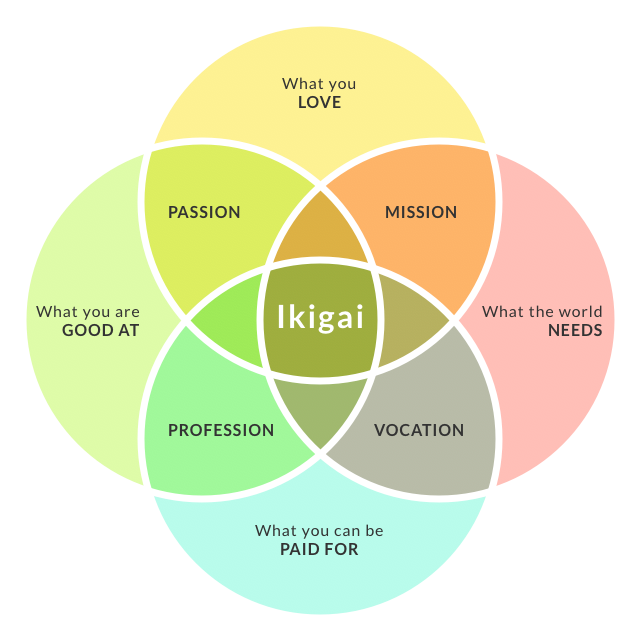
There is also a concept of ikigai that has four elements:
This is pretty much the same thing, except breaking out the “economic engine” into two elements of “world needs it” and “you can get paid for it.” I prefer the simpler, three-element version.
I like this framework and have recommended it, but I now see a couple of ways you can mis-apply it:
One is to assume that you can’t be world-class at something, especially if you have no background, training, credentials, or experience. None of those are necessary. If you are talented, passionate, and disciplined, you can often become world-class quickly—in a matter of years.
Another is to assume that there’s no market for something, no way to make a living. If something is important, if the world needs it, then there is often a way to get paid to do it. You just have to find the revenue model. (If necessary, this might be a nonprofit model.)
Important, tractable, neglected
Another model I like comes from the effective altruist community: find things that are important, tractable, and neglected. Again, we can negate each one to see why all three are needed:
If a problem isn’t tractable, then you’ll never make progress on it
If it isn’t neglected, then you can’t contribute anything new
If it isn’t important, again, why bother?
This framework was developed for cause prioritization in charitable giving, but it can also be naturally applied to choice of project or career.
Again, though, I think this framework can be mis-applied:
It’s easy to think that a problem isn’t tractable just because it seems hard. But if it’s sufficiently important, it’s worth a lot of effort to crack the nut. And often things seem impossible right up until the moment before they’re solved.
Sometimes a problem is not literally neglected, but everyone working on it is going about it the wrong way: they have the wrong approach, or the efforts just aren’t high-quality. Sometimes a crowded field needs a new entrant with a different background or viewpoint, or just higher standards and better judgment.
The other problem with applying this framework to yourself is that it’s impersonal. Maybe this is good for portfolio management (which, again, was the original context for it), but in choosing a career you need to find a personal fit—a fit with your talents and passions. (Even EAs recommend this.)
Ignore legibility, embrace intuition
One other way you can go wrong in applying any of these frameworks is if you have a sense that something is important, that you could be great at it, etc.—but you can’t fully articulate why, and can’t explain it in a convincing way to most other people. “On paper” it seems like a bad opportunity, yet you can’t shake the feeling that there’s gold in those hills.
The greatest opportunities often have this quality—in part because if they looked good on paper, someone would already have seized them. Don’t filter for legibility, or you will miss these chances.
My framework
If we discard the problematic elements from the frameworks above, I think we’re left with something like the following.
Pick something that:
you are obsessed with—an idea that you can’t stop thinking about, one that won’t leave you alone; even when you go work on other things for a while, you keep coming back to it
you believe is important—even if (or especially if!) you can’t fully explain it to the satisfaction of others
you don’t see other people approaching in the way that you would do it—even if the opportunity is not literally neglected
Ideally, you are downright confused why no one is already doing what you want to do, because it seems so obvious to you—and (this is important) if that feeling persists or even grows the more you learn about the area.
This was how I ended up writing The Roots of Progress. I was obsessed with understanding progress, it seemed obviously one of the most important things in the world, and when I went to find a book on the topic, I couldn’t find anything written the way I wanted to read it, even though there is of course a vast literature on the topic. I ignored the fact that I have no credentials to do this kind of work, and that I had no plans to make a living from it. It has worked out pretty well.
This is also how I chose my last tech startup, Fieldbook, in 2013. I was obsessed with the idea of building a hybrid spreadsheet-database as a modern SaaS app, it seemed obviously valuable for many use cases, and nothing like it existed, even though there were some competitors that had been around for a while. Although Fieldbook failed as a startup, it was the right idea at the right time (as Airtable and Notion have proved).
So, trust your intuition and follow your obsession.
]]>Jason CrawfordTwo mini-reviews2024-09-05T11:41:00-07:002024-09-05T11:41:00-07:00https://blog.rootsofprogress.org/james-scott-unabomber-reviewsTwo brief reviews of things I’ve read, one for everyone and one for my Substack subscribers.
James C. Scott says that “tragic episodes” of social engineering have four elements: the administrative ordering of society (“legibility”), “high-modernist” ideology, an authoritarian state, and a society that lacks the capacity to resist.
This is a bit like saying that the worst wildfires have four elements: an overgrowth of brush and trees, a prolonged dry season, a committed arsonist, and strong prevailing winds. One of these things is not like the others!
The book reads as a critique of “high modernism” and of “legibility” (and the former’s attempt to create the latter). And there is a grain of truth in this critique. But it should be a critique first and foremost of authoritarianism.
But Scott is an anarchist, not only politically but metaphysically. So he doesn’t just criticize authoritarianism. He criticizes the very attempt to find, or to create, order and system. All such attempts are misguided, all order is false, all “legibility” is fake.
He goes on at length about how farmers know their land and crops so much better than any Western outsider with their “science” ever could! He ignores cases like Borlaug’s Green Revolution, where importing the products of Western science revolutionized agricultural productivity.
So I disagree with the philosophical upshot of the book. That said, it was fascinating and contained many amazing facts and stories. Worth reading for the stuff about Le Corbusier alone. E.g., this quote from Le Corbusier is mind-bending in its detachment from reality:
Any architect, I imagine, supposes that the dwellings she designs will contribute to her clients’ happiness rather than to their misery. The difference lies in how the architect understands happiness. For Le Corbusier, “human happiness already exists expressed in terms of numbers, of mathematics, of properly calculated designs, plans in which the cities can already be seen.” He was certain, at least rhetorically, that since his city was the rational expression of a machine-age consciousness, modern man would embrace it wholeheartedly.
PS: To be clear, there are more lessons to take away from Seeing Like a State than just “authoritarianism is bad.” At its best, the book is a critique of technocracy.
Given that Ted Kaczynski, aka the Unabomber, was a terrorist who killed university professors and business executives with mail bombs and who lived like a hermit in a shack in the woods of Montana, I expected his 35,000-word manifesto, “Industrial Society and its Future,” to read like the delirious ravings of a lunatic.
I was wrong. His prose is quite readable, and the manifesto has a clear inner logic. This is a virtue, because it’s plain to see where he is actually right, and where he goes disastrously wrong.
Techno-humanism is a type of humanism. Humanism (as stated in Steven Pinker’s Enlightenment Now) is “the goal of maximizing human flourishing—life, health, happiness, freedom, knowledge, love, richness of experience.”1
Implicit in this goal is that humans deserve to flourish. A hallmark of the techno-humanist worldview is love for humanity, including reverence for human creations.
This was once a common sentiment in the West. Indeed, it is ancient: Sophocles’s Antigone features an “Ode to Man” that begins: “Numberless are the world’s wonders, but none more wonderful than man.”2 The Ode praises mankind’s ability to sail the seas, to plow the earth, to tame animals, to secure ourselves from wind and rain. “O clear intelligence, force beyond all measure!” Two thousand years later, this was echoed in Shakespeare: “What a piece of work is a man, How noble in reason, how infinite in faculty, In form and moving how express and admirable, In action how like an Angel, In apprehension how like a god, The beauty of the world, The paragon of animals.”3
Today there is a significant current of anti-humanism. In the last chapter, I quoted one environmentalist who called humans a cancer and a plague upon the earth; this was echoed in 2020, at the beginning of the covid pandemic, with the spread of the catchphrase “we’re the virus.”4 In 2018, a philosophy professor opined in the pages of the New York Times on the question “Would Human Extinction Be a Tragedy?” Although he acknowledged the tragic aspect of such an event, he called the issue “quite complex” and said that “it might just be a good thing” since humanity is “committing a wrong, a wrong whose elimination would likely require the elimination of the species.” (On the question of whether those alive today should commit suicide for the sake of animal welfare, he said “I do not have a final answer.”)5 Extreme views like these belong to a small minority, but their voices in national newspapers affect the mainstream mood, and dampen the enthusiasm of all but the most ardent humanists.
We need a corrective to anti-humanism. We need to reassert the value, the dignity, the glory of humanity. Consider this a modern Ode to Man.
Alone among all species on Earth, we have the ability to understand the nature of reality—from quarks to galactic superclusters, from the Big Bang to the heat death of the universe. We can diagram the structure of molecules we have never seen, analyze the composition of stars and planets from light-years away, recount the history of events from billions of years before we existed, and prove the properties of numbers that stretch to infinity. In the words of David Deutsch, we are “universal explainers.”6 Jacob Bronowski wrote in The Ascent of Man:
Physics in the twentieth century is an immortal work. The human imagination working communally has produced no monuments to equal it, not the pyramids, not the Iliad, not the ballads, not the cathedrals. The men who made these conceptions one after another are the pioneering heroes of our age.7
We have used that understanding to become the most successful species, obeying nature in order to command her. We have spread throughout the world and prospered in every environment. Our bodies are not adapted for the cold, but we can make fire and wear furs. Our bodies are not adapted for the ocean, but we can sail ships across it. Our bodies are not adapted for the mountains, but we can scale them with ropes and picks. Our bodies are not adapted for these circumstances, but our minds can adapt us to anything.
We have succeeded in part because we have learned to cooperate better than any other species. Large-scale cooperation is not inherent in our nature—colonies of insects work together in larger teams than primitive humans did8—but it emerges from our conceptual abilities. We are the only species that comes together to build cities, to unite into nations, to form global markets. We are the only species capable of specialization and trade. Adam Smith pointed out:
By nature a philosopher is not in genius and disposition half so different from a street porter, as a mastiff is from a greyhound, or a greyhound from a spaniel, or this last from a shepherd’s dog. Those different tribes of animals, however, though all of the same species, are of scarce any use to one another. The strength of the mastiff is not, in the least, supported either by the swiftness of the greyhound, or by the sagacity of the spaniel, or by the docility of the shepherd’s dog. The effects of those different geniuses and talents, for want of the power or disposition to barter and exchange, cannot be brought into a common stock, and do not in the least contribute to the better accommodation and conveniency of the species. Each animal is still obliged to support and defend itself, separately and independently, and derives no sort of advantage from that variety of talents with which nature has distinguished its fellows.9
We cooperate not only across all of civilization but across all of time: the human project is a cumulative one, stretching back to the hominin who fractured the first stone tool millions of years ago, and extending to the last colony in the last uninhabited solar system however many eons in the future. Our knowledge is cumulative: when anyone finds any fragment of Truth, they can share their discovery and thus enlighten the world. Karl Popper described scientists as “workers who are adding to the growth of objective knowledge as masons work on a cathedral.”10 Our technology is cumulative too, as is our wealth and our infrastructure. If not for this ability to build on what came before and to pass on what we have achieved, all of us would still be, not even huddling around campfires—since the use of fire was itself an invention—but shivering naked in the cold as we chewed on raw nuts and seeds or uncooked meat scavenged from other predators.11
On a biological scale, this project has erupted with astonishing speed. Life took eons to evolve. Single-celled organisms covered the planet for billions of years, fish and reptiles dominated for another few hundred million, mammals for tens of millions.12 Every animal before us lived their lives via mostly hardcoded patterns, with a relatively small role if any for learning.13 Evolution proceeded by natural selection, with less-fit organisms dying out or otherwise failing to reproduce. It was slow, each organism’s DNA getting only one chance to “learn” in a lifetime. Our evolution proceeds far more rapidly. In a short twelve thousand years we advanced from hunter-gatherer tribes to landing on the Moon.14
Our rapid advancement is driven by another uniquely human faculty that deserves our reverence: we are the only species that can criticize ourselves. Biological evolution “learns” through births and deaths, but with the ability to theorize and criticize, to paraphrase Popper, our ideas can die in our stead.15 The ability to criticize is the ability to improve. Nature gives to every animal drives, but we are the only species that can choose to rise above them: not to kill whoever attacks us, not to devour any food in sight, not to father or bear as many children as we can. We criticize and improve even our own institutions: replacing monarchy with democracy, authority with science, witch hunts with jury trials.
Our evolution has created the most marvelous artifacts: since our bodies have barely had time to evolve, we have instead created an extended phenotype of tools, machines, vehicles, buildings, and infrastructure.16 We build machines from tens of thousands of parts working in perfect symphony.17 We make geometric forms by pouring liquid stone reconstituted from pulverized rocks. We have given the globe a circulatory system of roads, rails, bridges and tunnels; and a nervous system of copper wire, fiber optics, and radio waves. We birth electronic brains by etching patterns on sand; today the transistor is even finer than the neuron.18 We forge columns of metal that breathe fire to escape the gravity of Earth and take us to the heavens. Having witnessed the Saturn V rocket that launched Apollo 11, Ayn Rand wrote that it represented “the concretized abstraction of man’s greatness”:
One knew that this spectacle was not the product of inanimate nature, like some aurora borealis, or of chance, or of luck, that it was unmistakably human—with “human,” for once, meaning grandeur—that a purpose and a long, sustained, disciplined effort had gone to achieve this series of moments, and that man was succeeding, succeeding, succeeding! For once, if only for seven minutes, the worst among those who saw it had to feel—not “How small is man by the side of the Grand Canyon!”—but “How great is man and how safe is nature when he conquers it!”19
Humans make up only 0.01% of the biomass of the Earth (far outweighing wild mammals and birds, but far less than fish, and dwarfed by trees).20 But human-made mass, from toothpicks to skyscrapers, now exceeds all living biomass, weighing in at over a trillion tons—a “symbolic characterization of the human-induced epoch of the Anthropocene.”21 To some, the fact of the Anthropocene is damning for humanity. To others, it is a neutral reality we should accept. To me, it is a badge of honor.
Our creativity goes far beyond bare material needs: we pursue knowledge for the sake of curiosity, art and music for the sake of beauty, game and sport for the sake of competition. We pursue ambitious projects for no reason other than the glory of the project, or to honor an abstract conception or religious ideal: temples, cathedrals, monumental sculpture, a clock in the desert that will run for ten thousand years.22
We are uniquely creative—and also uniquely destructive. We are not immune to the strife and conflict of the biological world; indeed we have prosecuted the most deadly conflicts. But we are also the only species that can rise above its animal nature and reduce conflict. We create custom, morality, and law. We establish constitutional republics, democratic elections, separation of powers, inalienable rights to freedom of speech and religion. We prohibit slavery, blood feuds, and wars of conquest.23 “When the laws are kept,” wrote Sophocles, “how proudly his city stands!”24
We are the only species that expresses love for others based not on evolutionary adaptations such as pair-bonding and kin relationships, but solely on our faculty of sympathy and admiration.25 And not just for our own species: we show love for other species as well. To them we may be a formidable enemy and a dominant competitor—but we also establish animal shelters and operate wildlife rescue programs, motivated purely by sentiment.
It is unfashionable to express reverence for humans—but no entity in the universe deserves it more. A species with this capacity for science and art, for inventiveness and creativity, for planning and building, for love and compassion, profoundly deserves to live, to thrive, and to expand to the planets and the stars.
Our cooperative nature means that not only are humans good, more humans are better.
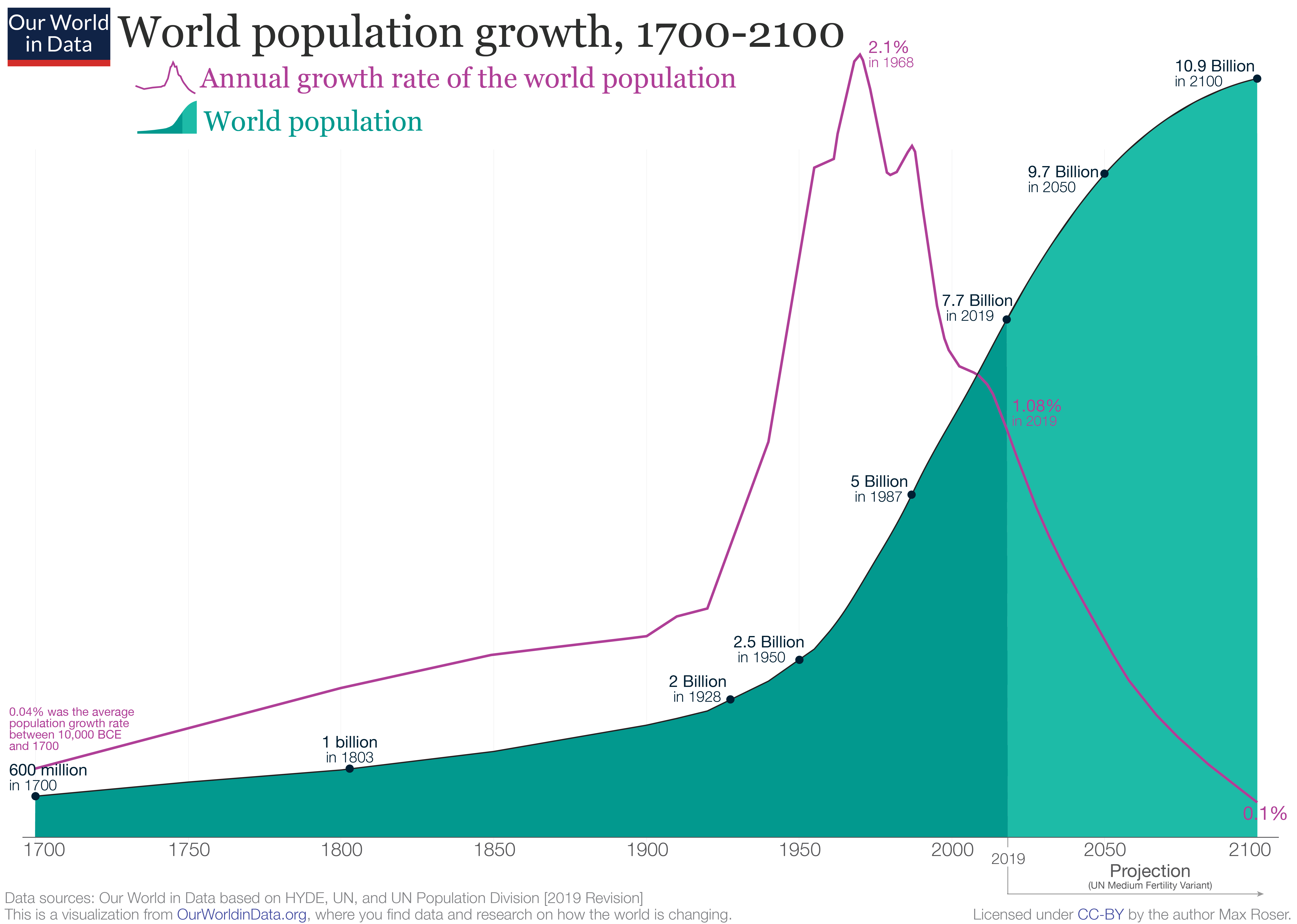
Thus we need a corrective not only to anti-humanism, but to anti-natalism and fears of overpopulation. Those fears were stoked in the 1960s, when the world population growth rate climbed to 2.3% per year while over 1.6 billion people were still living in extreme poverty.26 In 1968, Paul and Anne Ehrlich published The Population Bomb, which warned that “[i]n the 1970s… hundreds of millions of people are going to starve to death in spite of any crash programs embarked upon now.”27 The Ehrlichs said that population control should be achieved by compulsion if necessary, and supported coercive sterilization in India.28
1968, it turned out, was already past the peak population growth rate. Deaths from famine in the 1970s were the lowest in six decades, and only a small percent of the Ehrlichs’ hyperbolic forecast.29 Today population growth has fallen to 0.9%, and is projected to hit zero or negative before the end of this century, with world population peaking around ten or eleven billion.30 At the same time, world GDP per capita has almost tripled, and daily calorie supply has increased by 24% in Africa, 27% in South America and 49% in Asia.31
Despite what would seem like good news to someone worried about a population explosion, Paul Ehrlich maintains that “the most serious flaw” in his book “was that it was much too optimistic” (!) and said as recently as 2018 that the world’s ideal population is less than two billion people, a quarter of its present size.32 But Ehrlich is a piker compared to Jane Goodall, who said many of our problems would go away “if there was the size of population that there was 500 years ago”—that is, around 500 million people, a reduction of over 90%.33
Goodall and Ehrlich have it backwards: the ideal human population is not small and static, but large and growing. This is true not only in some aggregate sense, from a utilitarian viewpoint, but even from a selfish, individualistic viewpoint: a larger population is better for every individual.
First, more people means more outliers—more super-intelligent, super-creative, or super-talented people, to produce great art, architecture, music, philosophy, science, and inventions. If genius is defined as one-in-a-million level intelligence, then every billion people means another thousand geniuses, to work on all of the problems and opportunities of humanity, to the benefit of all. Of course, for every Einstein or Mozart, there is also a Hitler or Caligula. But society amplifies the accomplishments of the good, and fights to suppress the damage of the bad—which is why over the long term, we’ve created far more than we’ve destroyed.34
For other reasons, too, a larger population means faster scientific, technological, and economic progress. More people means more total research and development: more researchers, and more surplus wealth to invest in it. And it allows researchers to be more specialized and thus to go deeper in their fields. In the economy generally, the division of labor increases productivity, as each worker can specialize and become expert at their craft.35
R&D investment is also supported by larger markets, which let companies pick off higher-hanging fruit. The market for cancer drugs, for example, expands when large countries such as India and China become wealthier, bringing more people into the global middle class that can afford such drugs; this enables pharma companies to spend more on the fight against cancer.36 TSMC spends over $5 billion a year on R&D, which they can afford to do because they make over $60 billion a year by selling microchips worldwide.37
More generally, highly ambitious projects need a critical mass of resources behind them. Ancient Egyptian civilization built a large irrigation system to use the Nile floodwaters for agriculture, a feat that would not have been possible to a small tribe or chiefdom.38 The Apollo Program, at its peak in the 1960s, took over 4% of the US federal budget, but 4% would not have been enough if the population and the economy were half the size.39 If someday humanity takes on a grand project such as a space elevator or a Dyson sphere, it will require an enormous team and an enormous wealth surplus to fund them.
Even setting aside growth and progress—looking at a static snapshot of a society—a world with more people is a world with more choices, among greater variety. A bigger society has more cuisines, more architectural styles, more types of fashion, more sub-genres of entertainment. This also improves as the world gets more connected: for instance, the wide variety of ethnic restaurants in every major city is a recent phenomenon; it was only decades ago that pizza, to Americans, was an unfamiliar foreign cuisine.40
A bigger economy has more options for what to do with your life. In a hunter-gatherer society, you are lucky if you get to decide whether to hunt or to gather. In an agricultural economy, you’re probably going to be a farmer, or maybe an artisan. Today there’s a much wider set of choices, from pilot to plumber to accountant, from crane operator to lab technician to game designer.
A bigger world gives you a greater chance to find the perfect partner for you: the best co-founder for your business, the best co-author for your papers, the best lyricist for your songs, the best partner in marriage. Whatever your quirky interest, worldview, or aesthetic—the more people you can contact, the more likely you are to find others like you. Even if you’re one in a million, in a city of ten million people, there are enough of you for a small club. In a world of eight billion, there are enough of you for a thriving subreddit.
Similarly, in a larger, more connected economy, there are more people to economically support your idiosyncratic tastes. Your favorite Etsy, Patreon, or Substack creator can find the “one thousand true fans” they need to make a living.41
These examples illustrate a few value-generating effects of a larger population. One is economies of scale: fixed costs are amortized over more output, lowering average cost. There are also network effects: value in any network is generated by connections, and more people means more connections possible per person (the total number of possible connections is proportional to the square of the number of people).42 Finally, there is the existence of non-rival goods, which can be shared by all—especially ideas, which increase the productivity of everyone who uses them without diminishing the value of the idea for others.43
When Ehrlich and Goodall advocate for much smaller populations, they aren’t literally calling for genocide or hoping for a global catastrophe.44 Even so, the world they advocate is a greatly impoverished and stagnant one: a world with fewer discoveries, fewer inventions, fewer works of creative genius, fewer cures for diseases, fewer choices, fewer soulmates.
A world with a large and growing population is a dynamic world that can create and sustain progress.
Sophocles, “Ode to Man.” Note that “wonderful” is interpreted by other translators as “remarkable,” “strange,” or “formidable,” or in the sense of inspiring awe or even terror. But if not expressing love for man, Sophocles was certainly expressing respect and admiration. ↩
Shakespeare, Hamlet, Act 2, Scene 2. Note that Hamlet himself seems unimpressed with mankind, at least in his current mood: immediately after praising man he goes on to say “to me, what is this quintessence of dust? Man delights not me…” But this seems to be a way of illustrating his depressed state. ↩
“The population of a mature colony of Eastern subterranean termites ranges from around 50,000 to several hundred thousand termites” (“Termite Biology”). ↩
“Many zooarchaeologists who study Early Stone Age faunal assemblages think it’s likely that at least some animal carcasses that were butchered by hominins, especially the larger ones, were obtained by scavenging” (Pobiner, “Meat-eating by Early Humans”). ↩
“The first evidence of cultivation and animal domestication in southwestern Asia has been dated to roughly 9500 BCE” (“When did the Neolithic Period begin?”) ↩
Human neurons range from 4 to 100 micrometers in diameter (“Neuron”); modern transistors range from about 5 to 45 nanometers (Salter, “World’s First 2nm Chip”). ↩
Ehrlich, Population Bomb: “We must have population control at home, hopefully through a system of incentives and penalties, but by compulsion if voluntary methods fail” (p. xi). “When [Chandrasekhar] suggested sterilizing all Indian males with three or more children, we should have applied pressure on the Indian government to go ahead with the plan … Coercion? Perhaps, but coercion in a good cause” (pp 165–6). ↩
Famine deaths in the 1970s totalled 3.4 million, according to Hasell and Roser, “Famines.” ↩
Bryan Caplan makes similar points in “The Expected Human”, in which he quotes Julian Simon, who argued for more humans, “each one of whom might be a Mozart or a Michelangelo or an Einstein,” and Herman Daly, who made the counterpoint about the chance of “getting another Hitler or Caligula.” ↩
An effect known as “Smithian growth”, after Adam Smith who emphasized it in Wealth of Nations.↩
“One thousand true fans” is Kevin Kelly’s concept of the paying audience a creative needs to find in order to support themselves (Kelly, “One Thousand True Fans”). ↩
]]>Jason CrawfordThe Surrender of the Gods, part 22024-08-06T10:58:00-07:002024-08-06T10:58:00-07:00https://blog.rootsofprogress.org/thm-ch2-the-surrender-of-the-gods-part-2Previously: The Present Crisis, Fish in Water.
The Surrender of the Gods, part 1, told the story of progress as a story of the expansion of human agency. The chapter concludes below.
The story of progress, then, is one of humanity gradually wresting our fate away from the gods and taking it into our own hands. It is a process of increasing mastery over nature.
The concept of “mastery” over nature makes many people cringe. The acceptable notion today is to live in “harmony” with nature. Conservationist Aldo Leopold called in 1949 for “harmony between men and land”;1 by now the phrase has become an environmentalist cliché.2 The United Nations extolled this “harmony” in their foundational 1982 World Charter for Nature, in at least nine Resolutions on Harmony with Nature, and in their Sustainable Development Goals.3
This vision of harmony rests on a romantic view of nature as a loving mother who provides for us and protects us. In statements for “International Mother Earth Day,” the UN has called Mother Earth “the source of all life and nourishment,” praised her as “[t]he one thing that remains to sustain the many waves of humanity,” and admonished humanity as her “delinquent child,” challenging us to repair relations with her.4 Greenpeace paints the same picture: one of their articles states that “we need nature to do what it does best: sustaining life it gives homes to”; another claims that nature “gives us what we need,” “protects us,” and even “could solve future problems.”5
The ideal of “harmony” with nature is often pitched in superficially humanistic terms, on the premise that “humanity’s well-being [is] derived from the well-being of the Earth.”6 But in practice it becomes a call to decrease human agency: to do less, limit impact, cede control. Reduce, relinquish, retreat. The UN calls for “decreased intake of new material resources” and “reduced environmental footprint.”7 “Degrowth” advocate Jason Hickel says that the objective “is to scale down the material throughput of the economy.”8 Indeed, a formula commonly used in environmental science is “IPAT”: impact = people × affluence × technology.9 Reducing impact, by this definition, means a smaller population using less technology to be poorer.
But slowing growth and limiting development isn’t living in harmony with nature—it is surrendering in a battle with nature, capitulating to her unreasonable demands. To truly live in harmony with nature, we must first dispel this romanticized vision of it. To love and respect nature, we must see it clearly for exactly what it is.
Nature is not a loving mother. It is supremely indifferent to human needs. It gives us sunshine, but also heat waves and drought; rain, but also flood; lush prairies, but also deserts and swamps. “Immune, inanimate, inhuman, it indifferently manifests itself in the thunderbolt and hailstorm, rabid bat, smallpox microbe, and ice crystal.”10
Untamed nature is fearsome, and was seen this way through most of history. The romantic view of nature is a modern luxury bred of technology and urbanization. Environmental writer Emma Marris says:
Wilderness has been seen throughout Western history as a source both of inexhaustible resources and of real peril…. Many European colonizers preferred towns and fields, where things were altogether safer, and they thought it progress when the land claimed for civilization expanded and savage nature shrunk. It wasn’t until societies attained a little safety, prosperity, and leisure that nature in its wildest aspect began to seem rather romantic.11
Comfortable in our climate-controlled homes and on our manicured lawns, we can easily forget nature’s perils, but those who were truly in touch with the land, just a few generations ago, could not. The poet Robert Service described them in “The Law of the Yukon,” which he wrote in the voice of Nature herself, as she speaks of the men who came to challenge her:
One by one I dismayed them, frighting them sore with my glooms;
One by one I betrayed them unto my manifold dooms.
Drowned them like rats in my rivers, starved them like curs on my plains,
Rotted the flesh that was left them, poisoned the blood in their veins;
Burst with my winter upon them, searing forever their sight,
Lashed them with fungus-white faces, whimpering wild in the night;
Staggering blind through the storm-whirl, stumbling mad through the snow,
Frozen stiff in the ice-pack, brittle and bent like a bow;
Featureless, formless, forsaken, scented by wolves in their flight,
Left for the wind to make music through ribs that are glittering white…12
Further, nature is not harmonious. “Harmony” means “agreement or concord.”13 But nature is full of strife and conflict. Every organism on the planet competes for resources. Different species literally eat each other alive and invade each other’s bodies to exploit them. Members of the same species vie for dominance and mates, even with their own kin. An adult male tiger, if it comes across cubs that are not its own, will kill them, and then mate with the mother.14 A black eagle, when it hatches, will peck its weaker sibling to death.15 Tennyson, reflecting on the mercilessness of nature, aptly described her as “red in tooth and claw.”16
This conflict is inherent in non-rational nature. The selective pressure of evolution creates organisms that ruthlessly compete with and mercilessly dominate anything that gets in the way of their survival and reproduction. Nature may, for a time, be in “balance”—as births are balanced with grisly deaths, and predators with prey—but it is never in “harmony.”17
It is only human rationality that has enabled us, slowly, to transcend eternal warfare and reach some semblance of peace and cooperation. It is only human rationality that has any hope of creating harmony.
But that harmony requires the ability to commit to agreements and abide by norms. It is not possible to reach agreement with blind, non-rational nature. The only way to truly live in harmony with nature—to find agreement or concord with it—is unilaterally: to arrange its parts and direct its forces so as to best support human life. Nature absolutely enforces its immutable laws, which we ignore at our peril, but there is no reason to resign ourselves to the chance configuration of matter and energy it gives us. Using the former, we can control the latter.
Bacon said that to command nature, we must obey it.18 In the same spirit, we can say that to live in harmony with nature, we must master it.
To master nature is not to abuse or waste it; this isn’t a call to trash the planet or to pave it over for a parking lot. Nature is immensely valuable. It deserves our love and respect; we should care for and protect it. But we can conceive the value of nature entirely in human terms.
First, the environmentalists are right that human flourishing depends on the environment. The soil, the rivers, the forests support our lives and well-being. Stewart Brand says we should “think of ecosystem services as infrastructure. A bridge is infrastructure, and so is the river under it. … Radio spectrum is infrastructure, and so is an intact ozone layer.”19 We should maintain natural infrastructure diligently, as we would a sewer or a power grid. And we should be mindful that nature is a complex system, whose behavior is difficult to predict or control. But there is no reason to consider the original, “pristine” state of nature as an ideal, or to minimize our impact on it. On the contrary, we should upgrade and improve it—as we do when we clear fields, dredge rivers, or control animal populations.
We should return to grand geological engineering projects, such as canals, dams, and land reclamation. Once we were boldly ambitious on this front. The Suez and Panama canals severed continents from one another and shortened travel distances by thousands of miles.20 (Would these projects survive environmental review or activist obstructionism today?) Much of the land in major coastal cities including New York, San Francisco, and Boston was reclaimed from the ocean.21 Technologist Casey Handmer recently proposed to revitalize the Salton Sea and eliminate drought on the Colorado River by using solar power to desalinate water sourced from the Gulf of Mexico.22 Whether or not this plan should be adopted, it represents the scale we should be thinking on.
The environmentalists are also right that nature has great spiritual value. The grandeur of the mountains, the seclusion of the forest, the sense of freedom on the open seas, are aesthetic experiences that restore and inspire us. But even to enjoy the beauty of nature, we control it. “The setting aside of wild nature is no less a human choice, in service of human preferences, than bulldozing it,” says the Ecomodernist Manifesto.23 The most beautiful spots in nature are rare; we discover them, map them, and cordon them off in national parks. We find trails through the woods, mark and maintain them, upgrade them with stairs and railings for comfort and safety. We clear campgrounds and control dangerous animals. We ensure supplies of clean water. We stock medical necessities within reach. Our enjoyment of nature is an artificial experience.
A human-centered value system can also recognize a value in animal welfare. It is a psychological value: we feel sympathy for animals as fellow living creatures, and we hate to see them suffer or be abused. We value animals to the extent that they are attractive, show capacity for joy and pain, and do not pose a threat to human life. People care more about polar bears, elephants, and dolphins than about snakes, shrimp, or mosquitoes.24
Animal welfare is a luxury we purchase with technology and wealth. Tribal hunters would readily sacrifice animal welfare for their needs: some native American tribes would run an entire herd of bison off a cliff, creating a pile of corpses to use; one such site in Montana contains “up to eighteen feet of compacted buffalo remains.”25 Today, in contrast, many people pay extra for eggs from free-range chickens. In the future, synthetic foods such as lab-grown meat may replace livestock entirely.26 But any comfort we are willing to provide to animals, and any scruples we have concerning their treatment, are based entirely on our sympathy for them (and must fit within the resources we can reasonably devote to this cause).
In short, this is an affirmation of anthropocentrism: placing humans at the center of our moral code.
One movement within environmentalism, known as ecomodernism, rejects the romanticized view of nature and embraces a more human-centric approach. Ted Nordhaus and Michael Schellenberger, founders of the ecomodernist Breakthrough Institute, wrote in 2011 that we must “abandon both the dark, zero-sum Malthusian visions and the idealized and nostalgic fantasies for a simpler, more bucolic past in which humans lived in harmony with Nature.”27 Ecomodernism “offers a positive vision of our environmental future, rejects Romantic ideas about nature as unscientific and reactionary, and embraces advanced technologies, including taboo ones, like nuclear power and genetically modified organisms, as necessary to reducing humankind’s ecological footprint.”28
The ecomodernism of the Breakthrough Institute and of writers such as Stewart Brand is closely allied with techno-humanism, and I agree with them on most issues. But my anthropocentrism is even more radical: there is no need to reduce our “ecological footprint,” and no reason, as stated in the Ecomodernist Manifesto, that “humanity must shrink its impacts on the environment to make more room for nature.”29
Another wing of the environmentalist movement explicitly rejects anthropocentrism in favor of “biocentrism.” As biologist David Graber30 explained, this refers to “those of us who value wildness for its own sake, not for what value it confers upon mankind”:
I, for one, cannot wish upon either my children or the rest of Earth’s biota a tame planet, a human-managed planet, be it monstrous or—however unlikely—benign. … We are not interested in the utility of a particular species, or free-flowing river, or ecosystem, to mankind. They have intrinsic value, more value—to me—than another human body, or a billion of them. Human happiness, and certainly human fecundity, are not as important as a wild and healthy planet. [emphasis added]31
The intrinsic value of nature, then, is different from the aesthetic value of a beautiful landscape, or the psychological value of animal welfare. It is explicitly divorced from human happiness, from any value to humanity.
But the very idea of the intrinsic value of nature is incoherent. There is no way to value nature for its own sake, because nature is not one thing with goals or desires. The interests of different species and different individuals are in constant tension. If we optimize for the zebra, we harm the lion. The climate that is best for the gila monster is terrible for the emperor penguin. To repeat, nature is inherently full of strife and conflict.
If there were some standard of what is good for nature, then we could actively work to improve it. If it’s bad for species to go extinct, isn’t it good to de-extinct them through genetic engineering? Environmental ethicists have called de-extinction a “misallocation of effort,” a “risky ecological experiment,” and a flat-out “bad idea.”32 If it’s bad for the climate to change, isn’t it good to stabilize the climate through geoengineering? Almost four hundred scientists signed an open letter calling for an international non-use agreement on solar geoengineering, and a mere experiment with the technology planned at Harvard “was halted after objections by environmentalists and Indigenous leaders.”33 If thriving, biodiverse ecosystems are good, isn’t it good to create new ones—say, on Mars, through terraforming? Carl Sagan wrote, “If there is life on Mars, I believe we should do nothing with Mars. Mars then belongs to the Martians, even if the Martians are only microbes.”34 Although these criticisms are usually framed as practical concerns over specific harms, and reasonable people could differ on any particular issue, the consistent theme is: opposition to human intervention in any form.
If we can’t optimize on nature’s behalf, perhaps we should simply try to maintain stasis, limit change, reduce our “footprint”? Emma Marris writes:
For many conservationists, restoration to a prehuman or pre-European baseline is seen as healing a wounded or sick nature. For others, it is an ethical duty. We broke it; therefore we must fix it. Baselines thus … become the good, the goal, the one correct state.35
But there’s no reason to privilege the configuration of atoms that just happened to exist before humans. And to do so would be profoundly unnatural. Every organism changes its environment: consuming resources, constructing shelter, producing waste. The algae cover the sea, the cattle graze on the grasslands, the beavers dam the rivers. Many animals dig tunnels or burrows, or build nests or hives. The coral reefs greatly altered the marine environment when they formed hundreds of millions of years ago.36 Perhaps the greatest change to the environment in Earth’s history was the Great Oxygenation Event some two billion years ago—caused by cyanobacteria. (Owing to the mass extinction of anaerobic organisms that probably followed, it is also known as the Oxygen Holocaust.)37
Humans modify our environment like every other species, we just do it more successfully and on a grander scale than most. And unlike the cyanobacteria, when we change the composition of the atmosphere, we have the potential to know what we are doing and to mitigate any harmful effects. But like all organisms, modifying our environment is how we live. To limit it is to limit human life. To limit us, and not other animals, is to single out humans for punishment and degradation.
What, after all, is “nature”? A bird’s nest or an anthill is natural; a two-story condominium is unnatural. A chimp cracking a nut with a stone is natural; a human using a nutcracker is unnatural. If a river changes course because it erodes its banks and overflows them, that is natural; if it changes course because humans dug a canal, that is unnatural. If its banks are eroding and humans build a levee to stop it from changing course, that is also unnatural.38 Global warming is natural if caused by an interglacial period, but unnatural if caused by industrial CO2. Global cooling is natural if caused by stratospheric injection of sulfur dioxide from volcanoes, but unnatural if caused by stratospheric injection of sulfur dioxide from balloons.
The only coherent definition of “nature” here is: the negation of humanity. The absence of human agency. Nature is whatever is not us, whatever we did not choose to do or create. It is the world as we found it, as it happened to us, rather than the world we made.39 An essay published by the Sierra Club explains:
The wild persists as a place that remains undominated (if not untouched) by humans. A wild land is self-willed and sovereign—the rivers are free, the animals free, the fires free. … We need some spaces free of human intention, places where the herds still freely roam and the rivers are undammed.40
To place intrinsic value on nature, then, is ultimately nihilistic and profoundly anti-human. Continuing the quote from David Graber above:
I know social scientists who remind me that people are part of nature, but it isn’t true. Somewhere along the line… we quit the contract and became a cancer. We have become a plague upon ourselves and upon the Earth. … Until such time as Homo sapiens should decide to rejoin nature, some of us can only hope for the right virus to come along.41
Radical anthropocentrism is an extreme stance, and I don’t expect everyone to endorse it, even among techno-humanists. Many of my colleagues value animal welfare, biodiversity, or the environment in general, and aren’t comfortable with basing all of these on human well-being. Some, on utilitarian grounds, place fundamental moral worth on all sentient experience.42 Others may adopt a Christian view in which the Earth belongs neither to humans nor to animals, but to God (which can lean more or less anthropocentric depending on how much one emphasizes God giving man dominion over the Earth43 versus our responsibility to be stewards of God’s creation44). But I am stating my position here in order to stake it out, and because I believe my conception of the value of nature is the only consistent position that deserves the title of “humanism.”
In The Control of Nature, John McPhee describes the quest for human agency as the
struggle against natural forces—heroic or venal, rash or well advised—when human beings conscript themselves to fight against the earth, to take what is not given, to rout the destroying enemy, to surround the base of Mt. Olympus demanding and expecting the surrender of the gods.45
Humanity grew up in a world ruled by those gods. Now, we wield godlike powers ourselves. Material progress has granted us this agency, and that is the greatest praise I can bestow on it.
For more about The Techno-Humanist Manifesto, including the table of contents, see the announcement. For full citations, see the bibliography.
Rhodes, Energy: A Human History, quoting Elaine Scarry ↩
Marris, Rambunctious Garden, 18. Corroborating this, Charles Mann writes in The Wizard and the Prophet (p. 372) that in the mid-19th century, “‘wilderness’ meant to most people wastelands full of dangerous creatures: places to be subdued.” ↩
Hans Rosling writes: “Have you heard people say that humans used to live in balance with nature? Well, yes, there was a balance. But let’s avoid the rose-tinted glasses. Until 1800, women gave birth to six children on average. So the population should have increased with each generation. Instead, it stayed more or less stable. Remember the child skeletons in the graveyards of the past? On average four out of six children died before becoming parents themselves, leaving just two surviving children to parent the next generation. There was a balance. It wasn’t because humans lived in balance with nature. Humans died in balance with nature. It was utterly brutal and tragic.” (Rosling, Factfulness, 87.) ↩
The technical term for this is the “phyloempathic hierarchy” (Paulhus, “The Phyloempathic Hierarchy”). This is a broad generalization. There are more philosophic approaches, based in utilitarianism, that use sentience as the basis of moral value, and take seriously the welfare of shrimp or wild animals (“Crustacean Welfare”, Matthews, “Wild Frontier of Animal Welfare”). ↩
“An Ecomodernist Manifesto.” Note that some ecomodernists are more human-centered than others. Alex Trembath, for instance, also writing for the Breakthrough Institute, says that “Anthropocentrism is one of the primary characteristics distinguishing ecomodernism from conventional environmentalism” (“Differences Between Ecomodernism and Effective Altruism”), and that “ultimately, the choice of how and where to protect nature will be a human one, driven not by what we have to do to survive, but what we want to do to thrive on an ecologically vibrant planet” (“Protecting Nature Because we Want to”). ↩
Not to be confused with popular author David Graeber, of “bullshit jobs” fame. ↩
For an excellent story of building levees to maintain the course of the Mississippi River, see “Atchafalaya” in McPhee, The Control of Nature, which is quoted towards the end of this chapter. Similar stories could be told of the Yellow River and other rivers around the world (Carter, “When the Yellow River Changes Course”). ↩
One environmental ethics textbook explicitly states that “environmental ethicists often employ a conception of nature on which something is natural to the extent that it is independent of human design, control and impacts” (emphasis original). (Valera, Global Changes, 85.) ↩
Genesis 1:28. Historian Lynn White blamed Christian anthropocentrism for “our ecologic crisis,” saying that it “not only established a dualism of man and nature but also insisted that it is God’s will that man exploit nature for his proper ends” (White, “Historical Roots of Ecological Crisis”). ↩
]]>Jason CrawfordThe Surrender of the Gods, part 12024-07-23T11:15:00-07:002024-07-23T11:15:00-07:00https://blog.rootsofprogress.org/thm-ch2-the-surrender-of-the-gods-part-1Previously: The Present Crisis, Fish in Water.
So far we have told the story of progress as one of humanity climbing out of poverty, isolation, disease and death into abundance, connectedness, health and safety. More fundamentally, it is a story of the expansion of human agency.
Our primitive ancestors lived at the mercy of nature. They ate what food they found: what edible plants happened to be growing nearby, what game they could catch. They fashioned tools, clothing, and shelter out of found materials: wood, stone, leaves and grass; the hide, hair, bones, or shells of animals. They might temper these materials with fire,1 but they could not fundamentally transform them. And as nomads, they were forced to limit their possessions to what could be carried. Until about ten thousand years ago, they did not even have draft animals; they controlled no power sources other than their own muscles.2
They had little choice of where to live: when local food resources ran out, they moved on—and they were constantly on the move. They had little choice of what to do with their lives, as any division of labor within the tribe was extremely limited—hunting, foraging, tool-making—and much of that determined by social roles.3 They had little choice of whom to socialize with: they were a part of the community they were born into.
When their environment changed, they had to simply react as best they could. They had little to no ability to predict the weather, or to grasp changes in climate. They had no techniques to prevent disease, not even washing hands or boiling water. They fell victim to attacks from wild animals and to raids from other tribes. We don’t have vital statistics from this era, but estimates of historical world population show very low growth rates for a very long time, which implies high mortality.4
Every aspect of their lives was dominated by chance factors in their environment. Although they lived as best they could; although they applied all their intelligence, effort, and will; and although they were surely no less clever and brave than you or I—the life they could create was still merely a tiny enclave carved out of a vast world.
The advent of agriculture and settled society over ten thousand years ago was a major leap forward in human agency. For the first time, we ate not the plants we found and the game we caught in the wild, but the crops we had sown and the livestock we had raised. We chose where to live and we made our homes, finally able to invest in them for the long term.
The first settlers and agriculturalists did not have much choice in these things, and their options were poor. They probably worked harder than hunter-gatherers, and they had smaller stature, indicating worse nutrition.5 Some have interpreted the shift to agriculture as a mistake, even “the worst mistake” in history.6 More likely, hunter-gatherers were led or forced into agriculture by circumstances beyond their control, such as rising population density or changes in climate.7 To call this evolution a “mistake” is ahistorical: a mistake implies a choice, but primitive peoples had no ability to direct the course of their societies, nor even to comprehend when a change of this magnitude was occurring. The lesson instead is the extremely limited agency of hunter-gatherer societies: even if they enjoyed their lifestyle, they were unable to keep it when the environment changed.
In any case, those who did choose to settle down laid the foundation for a much greater and more powerful civilization. With permanent settlements, we could accumulate possessions, including things too heavy to carry. Crucially, we could build large furnaces. And with them, we could generate the intense heat needed to transform materials: to smelt metals, to blow glass, to kiln clay and limestone. We had leapt beyond wood, stone, and other found materials, to create new materials that vastly expanded our options: metal afforded new types of tools, glass and ceramic new ways of storing food, cement and brick new methods of building.
Even this small bloomery furnace cannot be carried by nomads.
Wikimedia / Przykuta
We began to harness energy beyond our own muscle and channel it to our purposes: wind, water, animals. We guided and magnified it using gears, levers, pulleys, and screws. These afforded new ways to grind grain, saw wood, or lift stones and beams—whether to lighten our load, or to increase our strength.
With new materials and energy sources, we began to refashion the world we had found into a new and distinctly human world. We plowed fields, paved roads, dammed rivers. We built cities full of homes, shops, palaces, temples. We connected the continents via great ships that crossed oceans, effecting a global redistribution of crops, livestock, and people.
In this new world a much greater range of professions was open. While most workers still labored in the fields, some could specialize in the crafts: blacksmithing, weaving, pottery, carpentry. A few could become merchants or sailors, and travel the world. A very privileged few were even able to devote themselves to knowledge, law, art, or religion.
By this era, humanity had already far surpassed any other species; our command of nature was unmatched. And yet, by today’s standards, these people were still helpless.
Every human endeavor was vulnerable to random shocks and failures. Agriculture could fail due to drought, frost, blight, or pests. Even under the best circumstances, productivity was very low: about 1,000 kg of cereal-equivalents per worker per year, barely enough to feed the worker himself and his own family.8 With small surplus and little ability to reserve it for hard times or to transport it to the relief of stricken regions, famine was common.9
Manufacturing processes were variable and unpredictable. The iron-maker could not set his furnace to a precise temperature, because he didn’t have a thermometer, nor a concept of temperature that allowed for any precision. The ore he fed into that furnace contained impurities from nature, but he had no way of testing for them, nor the scientific knowledge to identify them. As late as the 1800s, blast-furnace managers were expected to have a feel for their furnaces and to run them by instinct.10 Finished products, from horseshoes to boilerplates, were fashioned by hand, between hammer and anvil or hand-operated rollers, and could have no more precision than hand and eye could coordinate.
Transportation of all forms was subject to the vagaries of the weather. Ships sailed by the grace of the wind, and could not move if it ceased to blow. The ability to navigate the open ocean was not widespread; most merchant voyages hugged the coast or plied a few known routes that followed seasonal monsoon winds.11 Travel on land was worse: slow, rough, and expensive; across a landscape filled with mountains, rivers, canyons, and other insuperable obstacles. Storms could cause shipwreck; rain could turn dirt roads to mud; snow could block a mountain pass for an entire winter.
Harnessing energy was also subject to chance. Windmills only turn when the wind blows. Water power was limited to river sites, and it would stop when the river ran low or froze over in winter. Neither can be stored, transported, or scaled up: they must be used when, where, and as they are found. For heating and lighting, too, we used found sources of energy: wood and coal, fats and oils, straw, brush, even animal dung—whatever was around that could burn. With little ability to purify our fuels, they gave off acrid smoke that damaged eyes and lungs.12
Disease was rampant. Epidemics were exacerbated by dense urban populations and by people living in close proximity to livestock. The control of disease was limited to very crude measures such as the quarantine and a few treatments such as cinchona bark for malaria. When plague struck, people turned to prayer and repentance. The sick did not even have the knowledge or ability to keep from infecting their own dearest loved ones.
It was still a world ruled by the gods, and humanity lived and died at their whim.
The Triumph of Death, Pieter Brueghel the Younger, 1626.
Wikimedia
Helplessness was such a feature of the human condition that it was seen as the right and natural order of things. In 1722, when inoculation for smallpox (a forerunner of vaccination) was gaining popularity in the West, one London reverend preached vehemently against it. Disease, he argued, was sent by God—“either for the trial of our faith, or for the punishment of our sins.” In any case, it was God’s prerogative alone to send disease, and indeed to arrange even “the most minute circumstances of life”:
Shall we presume to rival him in any instance of providence, find fault with his administration, take the work out of his hands, and manage for ourselves? … Let the atheist then, and the scoffer, the heathen and unbeliever, disclaim a dependence upon providence, dispute the wisdom of God’s government, and deny obedience to his laws: let them inoculate, and be inoculated, whose hope is only in and for this life!13
This trust in the wisdom of divine providence extended even to natural disasters. When a great earthquake and tsunami struck Lisbon in 1755, killing tens of thousands and destroying much of the city, commenters bent over backwards to justify this atrocity and absolve their God. Some called it a punishment for the wicked lifestyle of the inhabitants of Lisbon. Protestants said it was targeted at Catholics for prosecuting the Inquisition. Rousseau even blamed the destruction on humans, for choosing to build tall buildings in dense urban centers.14
This fatalism was gradually eroded by Enlightenment rationality and material progress. We mitigated the destruction from earthquakes not by abandoning cities, but by studying seismology and structural engineering, and then designing earthquake-proof buildings. When disasters strike today, from pandemics to financial crises, we do not attribute them to Providence; we call them failures of policy and leadership. We no longer consider random events to be uncontrollable—we insist on controlling them.
And we have now achieved unprecedented levels of control over our world. Both agriculture and manufacturing are now consistent and reliable. With irrigation, we no longer depend on rain; with pesticides and herbicides, we fend off attacks from nature. With chemical assays and computerized machinery, we process raw inputs from any source, of any makeup, and produce pure, consistent alloys, their composition measured to hundredths of a percent.15 And we have created not only abundance, but incredible variety: our supermarkets are stocked with dozens of flavors of every product from cereal to pasta sauce; our shopping malls are a paradise of material goods to suit every individual need, style, and taste.
We have mastered the use of energy. The invention of the engine enabled us to convert fuel into motion, breaking our dependence on inconstant power sources such as wind and water. Energy usage became reliable and scalable; we could deploy it anytime, anywhere. With industrial chemistry, we purified the fuel itself, so it burned with less soot, ash, and smell; with electricity, we tame the very lightning.
Social life is no longer limited to the community you happened to be born into. If your hometown does not excite you, you can find a more suitable one, almost anywhere on Earth. If you wish to learn your art or craft from a master, you can find the world’s best teachers and sit at their feet, virtually or literally. If your local community shuns you, you can find a supportive community online. You can participate in almost any marketplace on the planet: for both buyers and sellers, this opens up a world of choices and opportunities.
We have radical agency over our information diet as well—even though that is a contrarian position today. In the past, people heard what news happened to reach them, often via gossip and hearsay; now we have instant access to all the information in the world. Despite algorithmic feeds and social media bubbles, we have much more ability than at any time in history to escape our provincial worldview and adopt a more cosmopolitan one. Before printed books and libraries, fact-checking was near impossible; before the Internet, it was often prohibitively difficult; now it is almost trivial. Few people exercise these abilities as much as they should—but that has always been the case, and those who do exercise them have an outsized influence on the world. Besides, if you think the average person today is misinformed, compare them to the sailor who feared monsters at sea, or the villager who joined in literal witch hunts.16
Our command of the material world results in greatly expanded choice in our individual lives. More than ever, we can choose what work to do, where to live and when to move elsewhere, whom to marry (if anyone) and when, how many children to have (if any) and when to have them, whom to associate and keep in touch with, what art and entertainment to experience, how to express ourselves in style and fashion.
Not everyone is happy with this new world of expanded choice. Some people feel adrift on a sea of options, and look wistfully to a bygone era when they would have been shepherded into traditional social roles. Some commentators worry that with the fading of those traditions, people are making choices that leave them personally unfulfilled or erode the social fabric, such as avoiding marriage and children.17 This much is true: with greater choice comes greater responsibility to make good choices. But if people make poor ones, it’s a mistake to blame that on the expansion of choice itself, or on the material advances that helped expand it, or on the scientists, inventors and industrialists who created those advances. Instead, we should challenge moralists, teachers and parents to provide better guidance for how to live a good life and create a good society in a world of greatly expanded choice.
Another result of material progress is a more secure and stable world. Our control of disease, for instance, has never been stronger. This may seem audacious to declare mere years after the worst pandemic in living memory. But consider: When the Black Plague struck in the 1300s, we did not even have the germ theory to understand what was happening, and mass death ensued. When an influenza/pneumonia epidemic hit the world in 1918, we had neither a vaccine for the flu nor antibiotics for the pneumonia. When covid arrived in 2020, the scientific community used genomic surveillance to track its history and its spread, tested hundreds of treatments in parallel, and developed a vaccine in record time based on novel mRNA technology.18 The Plague is estimated to have killed 30% or more of the population it swept through; the 1918 flu killed about 3%; covid about 0.3%.19
Human agency sometimes advances two steps forward and one step back. Technology grants capabilities but also creates new hazards. But these hazards, too, we learn to control—and we are far better at this today than in the past.
Consider toxins and carcinogens. Lead and asbestos were in use since antiquity; only in the 20th century did we deeply understand their health risks and thoroughly remove them from our environment.20 Mercury and other poisons were once prescribed as drugs; now all pharmaceuticals undergo extensive toxicity testing.21 Common occupational hazards once included inhalation of smoke or coal dust, or exposure to phosphorus, benzene, or even radium.22 Health concerns today, such as damage from microplastics, are subtle, long-term effects compared to what people routinely faced in the past.23
Our maintenance of the planet follows the same pattern: we are far more aware of, careful about, and able to control and limit environmental damage than ever before. Primitive hunters drove megafauna to extinction around the world. Early agriculturalists deforested large swaths of land via slash-and-burn, which one historian calls “undoubtedly the greatest ecological destruction in history.”24 In all such cases, those responsible had no concept of the downstream effects of their actions, no way to detect or measure them, and no scientific framework to understand them. Even if they had known what they were doing, they would not have been able to formulate a response, or communicate it to other tribes, or coordinate its implementation.
Contrast this with a modern example of unintended environmental consequences: the degradation of the ozone layer by chlorine-containing chemicals such as CFCs. The effects were located in a minute quantity of an invisible gas several miles above our heads. The consequences were even further removed, such as skin cancer from increased ultraviolet radiation. No society before the 20th century would have had the means to follow such a subtle chain of causation, or to link a chemical used in aerosols with skin lesions elsewhere on the globe, decades later. If CFCs had been invented in the Victorian era, rates of skin cancer would have increased mysteriously for decades without anyone understanding why—probably without anyone even noticing, since statistics on cancer incidence weren’t kept until the mid-1900s. Today, we have the infrastructure to detect the problem: a network of balloons, satellites, and ground-based instruments continually monitoring the composition of all layers of the atmosphere. We have the chemical knowledge to identify ozone, the geophysical knowledge to link it with ultraviolet radiation, and the medical knowledge to link radiation with cancer. We have the surplus wealth to invest in a scientific community that does all these things. We have the communications technology to spread the news when we discover problems like this. And we have the institutions to coordinate an international response, almost completely phasing out ozone-depleting chemicals worldwide.25
The acceleration of material progress has always concerned critics who fear that we will fail to keep up with the pace of change. Alvin Toffler, in a 1965 essay that coined the term “future shock,” wrote:
I believe that most human beings alive today will find themselves increasingly disoriented and, therefore, progressively incompetent to deal rationally with their environment. … Change is avalanching down upon our heads and most people are utterly unprepared to cope with it … Such massive changes, coming with increasing velocity, will disorient, bewilder, and crush many people.26
Toffler and others worried that as progress moves ever faster, the world will slip out of our grasp. But as we have just seen, the historical trend is the opposite: the world does change ever faster, but we get better at dealing with change. We can better comprehend change, thanks to scientific theories, instruments of measurement, monitoring systems, and global communications. We can better respond to it, thanks to technology, wealth, and infrastructure, especially our manufacturing and transportation infrastructure. And we can better coordinate that response, via corporations, markets, governments, and norms of international cooperation. Change has been accelerating ever since the Stone Age, but we can far better handle the changes in our fast-paced world than tribal hunter-gatherers, Bronze Age emperors, or medieval kings could handle the changes even in their relatively slow-moving ones. All of those societies faced existential risk from factors as simple as a shift in climate or a new pathogen: famine, plague, or war could and did cause civilizational collapse.27
Other critics have feared that, since technology is distinct from ourselves, progress therefore weakens us and makes us dependent on an alien object, or even enslaves us to our machines. As early as 1863, Samuel Butler warned:
Day by day… the machines are gaining ground upon us; day by day we are becoming more subservient to them; more men are daily bound down as slaves to tend them, more men are daily devoting the energies of their whole lives to the development of mechanical life. …
Our opinion is that war to the death should be instantly proclaimed against them. Every machine of every sort should be destroyed by the well-wisher of his species. Let there be no exceptions made, no quarter shown; let us at once go back to the primeval condition of the race. If it be urged that this is impossible under the present condition of human affairs, this at once proves that the mischief is already done, that our servitude has commenced in good earnest, that we have raised a race of beings whom it is beyond our power to destroy, and that we are not only enslaved but are absolutely acquiescent in our bondage.28
But if we are “slaves” to our machines, then the peasant farmer is a slave to the weather and the soil, and the hunter-gatherer is a slave to wild plants and game. To use the term “slavery” for any external influence or constraint is to destroy the concept. We exist in nature and must make our way in it; that is not slavery but natural law. We can choose to do so well or poorly, to have robustness or insecurity, to live using machines and systems of our own design, or at the mercy of luck and chance. To move from the latter to the former is not slavery but liberation.
To be continued in part 2 of this chapter.
For more about The Techno-Humanist Manifesto, including the table of contents, see the announcement. For full citations, see the bibliography.
Correction: Quinine is effective against malaria. However, it was not available until the early 1800s; previously malaria was treated with cinchona bark. Thanks to Julian Jamison and Greg Salmieri for pointing out this error.
Blockmans et al. The Routledge Handbook of Maritime Trade around Europe 1300-1600, 19; Bernstein, A Splendid Exchange, 81-82, 101. A notable exception is the Polynesians, whose navigational skills helped them expand throughout the Pacific islands. ↩
Semyonova Tian-Shanskaia, Village Life in Late-Tsarist Russia, 119. Even today, in the poorest regions, indoor air pollution is a top health hazard: see Ritchie, “Indoor Air Pollution.” ↩
Almeida Marques, “Paths of Providence.” Rousseau was responding to Voltaire’s “Poem on the Lisbon Disaster,” which rebutted many of the apologists who said that the earthquake was a just punishment or that it was somehow for the best. ↩
Stoddard, Steel: From Mine to Mill, the Metal that Made America, 157. ↩
]]>Jason CrawfordFish in Water2024-07-16T10:38:00-07:002024-07-16T10:38:00-07:00https://blog.rootsofprogress.org/thm-ch1-fish-in-waterPreviously: “The Present Crisis” (Introduction).
It may seem odd that progress needs a defense.
The triumph of science, technology and industry has been told many times over—as the Great Enrichment, the Great Escape, or the Great Surge; the Origin of Wealth or the Birth of Plenty; the Rise of the Western World or simply the Ascent of Man.1 Its scorecard over the last few centuries is legendary: more than a twenty-fold increase in GDP per capita in developed nations, and a reduction in extreme poverty from almost 80% of the world to less than 10%; more than a doubling of global life expectancy at birth, including a tenfold reduction in child mortality; an increase in basic education and literacy rates from about 15% to over 85%.2 For such staggering benefits, what cost could be too high? For so many lives saved, what risk too great?
But for most people in wealthy countries, the problems of poverty, child mortality, or illiteracy are no longer in living memory. And the vast machine that delivers our unprecedented prosperity is all but invisible. We see its products—fresh food, cheap furniture, paved roads, clean water, streaming music—but we seldom ask where they came from or how they were created, even if we are dimly aware that humanity did not always enjoy their blessings. And so it becomes all too easy to take them for granted.
You can eat a meal—wolfing it down with one hand while checking the news on your smartphone with the other—without a second thought to the tractors and harvesting machines, the irrigation pipes, the industrial furnaces making synthetic fertilizer, the researchers in the lab breeding and engineering hardier varieties of crops. And you can easily forget that not long ago, being able to eat a meal at all was considered a gift, for which thanks are traditionally given to God.
You can amass a closet full of outfits, in a variety of styles and colors, with no knowledge of the spinning machines, the dyeing vats, the automatic looms, the sewing machines, or the tremendously efficient factory system they are a part of—the system that has turned this kind of product from a luxury for the rich into a commodity available to the average worker. And no one will remind you that this work was once done by hand, using only basic tools and a lot of manual dexterity, in routine, monotonous motions, by a large fraction of the workforce.
You can walk into a room and unconsciously flick on the light, unaware that you are summoning powerful forces in distant structures, rousing multi-ton turbines powering electric dynamos, to deliver energy via invisible force fields that ripple through a web of transmission lines and route it to your exact location. You have probably already lost count of how many times you have done this today.
You can relax in the evening with streaming movies or music, even if you do not know the binary language of computers, or how to program them, or the rules of the protocols that they follow when they exchange information. If you put on a period piece from Netflix, however, you may be reminded that in the time of your great-great-grandfather, sound and video could not be recorded in any form, and to experience the world’s best performers was a luxury for wealthy city-dwellers.
If you get an infection, you can treat it with an antibiotic, whether or not you are aware of the researchers who discovered it, or the extensive trials that were performed to determine its safety and efficacy, or the meticulous manufacturing processes that ensure its purity. And no one will point out that less than a century ago, there would have been little if anything the doctors could have done to prevent your death.
The comforts of the modern world are among its greatest achievements. But by their nature, those achievements detach us from the harsh reality of daily life that used to be the norm. We don’t smell the stench of sewage or horses in the streets, we aren’t burned by the sun while laboring in the fields, we don’t feel the weight of a pail of water as we carry it back from the well. We don’t worry about whether the crops will fail from drought or frost, or whether the creek will flood and wash out the footbridge, or whether we’ll have enough firewood to last the winter, or whether a brother will be lost at sea on his two-month voyage across the Atlantic, or whether a child will die from a scrape by a rusty nail. Life is convenient, comfortable, predictable, safe, and clean, in a way that’s hard for any of us to appreciate.
Industrial civilization has become a victim of its own success: it has solved the problems of daily existence so thoroughly, and with such finesse, that the solutions and even the problems fade from our collective memory. Like fish in water, we are so immersed in technology and industry, so completely dependent on it every day of our lives, that it recedes into the background, out of our awareness. We only notice the inverse: the rare occasions when the heat doesn’t work, or the water isn’t clean, or the store shelves are empty, or there is a power outage—or even a wi-fi outage. Indeed, many of these events are national news.
We forget that in many ways the average person in a developed economy lives better than royalty of old. Fruits and spices that were once exotic symbols of luxury and prerogative are now found in bulk in the supermarket.3 Clothing in colors once reserved for emperors are now sold off the rack at TJ Maxx.4 In winter, our homes are more comfortable than Louis XIV’s palace at Versailles: in its grand Hall of Mirrors, despite two fireplaces, it was “advisable to wear furs for added protection,” and the wine and water sometimes froze in the glasses.5
We forget that everything had to be invented, even the most mundane features of daily life. Basic fasteners such as the zipper, the paper clip, the safety pin, and the rubber band were not invented until the 1800s.6 Simple food containers such as soda cans, plastic bottles, and milk cartons required a remarkable amount of engineering: to choose the right materials, to make them easily openable, to manufacture them cheaply.7 The toothbrush was first mass-manufactured in the late 1700s; earlier, people cleaned their teeth with rags (and incidentally, the bristles were typically made of pig hair until Nylon was invented in the late 1930s).8 Much of our road infrastructure is surprisingly recent: streets were not paved with tar or asphalt until the 1800s, stop signs and three-color traffic lights were introduced in the 1910s, the striped “zebra” crosswalk in 1951.9 Ancient writing systems lacked features we consider obvious, such as capitalization, punctuation, or even spaces between words.10 Many household items solve problems that we forget anyone ever faced: matches, invented in the early 1800s, could light a stove with much less trouble than flint and steel (although even this is now made obsolete by gas and electricity); the ballpoint pen, invented in the 1930s, saved many clothes and tablecloths from spilled ink; the can opener was not invented until a few decades after the food can—previously, cans had typically been opened with hammer and chisel.11
We forget the intense isolation of the past; for us, living in a world of instant global communications, it is almost impossible to grasp. The average medieval villager never traveled more than dozens of miles from home.12 Even in 19th-century America, in rural areas, “the overwhelming impression from today’s perspective is isolation. … Poor transportation kept farmers from social gatherings with those beyond a radius of a few miles reachable by horse and buggy … Many members of farm families never traveled outside the county in which they were born.”13 To journey long distances was epic: as late as the 1860s, to go from New York to San Francisco, whether by land or sea, took six months, and the travelers were risking their lives.14 News traveled slowly, sometimes with tragic consequences: the Battle of New Orleans, where over 2,000 people died, was fought after the treaty to end the War of 1812, because word of the peace had not yet reached the combatants.15 And if travel and communication were severely limited before the 20th century, so too was access to knowledge, art and culture in an era when even public libraries were not common and the average person received only a few years of formal schooling.16
We forget how dangerous, unstable, and frightening the world used to be. Famine was common through all of history before modern agriculture: historian Fernand Braudel says that “famine recurred so insistently for centuries on end that it became incorporated into man’s biological regime and built into his daily life.”17 Disease was rampant. In cities, smallpox was an accepted fact of life: one 18th-century observer likened it to “a thorny hedge through which all must pass, and some die, to reach a field of safety.”18 When epidemics struck, bodies were removed by the cartload; during the worst times, “when the hearses came round to remove the dead, the coffins were so numerous that they were put on top of the hearses as well as the inside.”19 Infant mortality was so high that some cultures would not even name a newborn until it had survived some weeks or months.20 Great fires often swept through cities. With only horse-drawn, steam-powered fire engines fed by inadequate municipal water systems, little could be done against a large blaze; sometimes tens of thousands of homes were destroyed.21 Our lives are tremendously safe and secure compared to the past.
We live in an amazing world, and we should stop taking it for granted. We should never forget how difficult, dirty, and dangerous life was for most people who ever existed. And once in a while, we should look at our world with a sense of awe and wonder that humanity could ever create it. We should look at the world with gratitude to those who came before us, and especially to the scientists, inventors, and entrepreneurs who labored, struggled, and fought to build it. This world and the standard of living we enjoy are the gift they left us. We can never pay it back. But we can pay it forward: we can keep progress going, and build an even better world for the generations to come.
For more about The Techno-Humanist Manifesto, including the table of contents, see the announcement. For full citations, see the bibliography.
McCloskey, “The Great Enrichment”; Deaton, The Great Escape; Radelet, The Great Surge; Beinhocker, The Origin of Wealth; Bernstein, The Birth of Plenty; North, The Rise of the Western World; Bronkwski, The Ascent of Man. ↩
Boylston, Defying Providence, 142, quoting the 1746 charter of a London smallpox hospital. ↩
Johnson, The Ghost Map, 109, quoting the London Observer. ↩
Bugos and McCarthy, “Ayoreo Infanticide.” When a child did die, names were sometimes recycled to use for the next baby (Fischer, Albion’s Seed, 94-97). ↩
]]>Jason CrawfordThe Present Crisis2024-07-09T10:39:00-07:002024-07-09T10:39:00-07:00https://blog.rootsofprogress.org/thm-introduction-the-present-crisisNever has humanity been so powerful, and at the same time so distrustful of our power.
We live in an age of wonders. To our ancient ancestors, our mundane routines would seem like wizardry: soaring through the air at hundreds of miles an hour; making night bright as day with the flick of a finger; commanding giant metal servants to weave our clothes or forge our tools; mixing chemicals in vast cauldrons to make a fertilizing elixir that grants vigor to crops; viewing events or even holding conversations from thousands of miles away; warding off the diseases that once sent half of children to an early grave. We build our homes in towers that rise above the hills; we build our ships larger and stronger than the ocean waves; we build our bridges with skeletons of steel, to withstand wind and storm. Our sages gaze deep into the universe, viewing colors the eye cannot see, and they have discovered other worlds circling other Suns; they have found the atoms of Democritus; they can tell us the system of the heavens and the mechanism of life; they can at long last turn base metals into gold.1 Once, these accomplishments, and their benefits to humanity, were referred to simply as “progress.”
But not everyone agrees that the advancement of science, technology, and industry has been such a good thing. “Is ‘Progress’ Good for Humanity?” asks a 2014 Atlantic article, saying that “the Industrial Revolution has jeopardized humankind’s ability to live happily and sustainably upon the Earth.”2 In Guns, Germs, and Steel, a grand narrative of civilizational advancement, author Jared Diamond disclaims the assumption “that the abandonment of the hunter-gatherer lifestyle for iron-based statehood represents ‘progress,’ or that it has led to an increase in human happiness.”3 Diamond also called agriculture “the worst mistake in the history of the human race” and “a catastrophe from which we have never recovered,” adding that this perspective demolishes a “sacred belief: that human history over the past million years has been a long tale of progress.”4 Historian Christopher Lasch is even less charitable, asking: “How does it happen that serious people continue to believe in progress, in the face of massive evidence that might have been expected to refute the idea of progress once and for all?”5 Economic growth is called an “addiction,” a “fetish,” a “Ponzi scheme,” a “fairy tale.”6 There is even a “degrowth” movement advocating economic regress as an ideal.7
These ideas are not confined to a niche of intellectuals: after permeating education, media, and entertainment for decades, they have become the zeitgeist. “Every group of people I ask thinks the world is more frightening, more violent, and more hopeless” than it is, said the global health expert Hans Rosling; even after presenting people with the facts, “they were still stuck in their old negative worldview. The new ideas just wouldn’t take.”8 A 2015 survey of several Western countries found that only a small minority think that “the world is getting better.”9 Another survey found that almost 20% of Americans think it was better to be born 200 years ago than today (with another 41% “not sure”).10 Nor are people hopeful for improvement. In 2023, over three quarters of Americans did not believe that life for their children would be better than their own, and only 24% were optimistic about the country’s future.11 Most worrying is that young people are particularly pessimistic: in a recent youth survey on climate change, 75% thought that “the future is frightening” and more than half agreed that “humanity is doomed.”12
With so little awareness of progress, and so much despair for the future, our society is unable to imagine what to build or to dream of where to go. As late as the 1960s, Americans envisioned flying cars, Moon bases, and making the desert bloom using cheap, abundant energy from nuclear power. We might criticize some pieces of this vision, but at least they had a vision. Today we hope, at best, to avoid disaster: to stop climate change, to prevent pandemics, to stave off the collapse of democracy.
From an advertisement by a coalition of power companies in the LA Times, 1959.13
This is not merely academic. If society believes that scientific, technological and industrial progress is harmful or dangerous, people will work to slow it down or stop it. Activists have obstructed all forms of energy—nuclear power, oil and gas, even solar and wind14—and the average American benefits from no more energy today than fifty years ago.15 The EU has largely banned the cultivation of GMOs,16 and opposition to Vitamin A–enhanced “Golden Rice” has prevented it from “saving millions of lives and preventing tens of millions of cases of blindness.”17 Sri Lanka created a food crisis for itself when it banned synthetic fertilizer in a hasty, bungled shift to “organic” farming.18 In medicine, romantic notions of “natural” health cause patients to shun treatment for cancer and vaccines for diseases; measles outbreaks are now on the rise.19
Even mere apathy puts progress at risk. New ideas are always vulnerable, and in every age, there are natural diseases of stagnation: fear of change, economic protectionism, the accumulation of bureaucracy. In the Middle Ages, guilds limited competition and resisted the introduction of new techniques.20 In the Industrial Revolution, textile workers smashed and burned the machinery that threatened their jobs.21 The first locomotives were opposed based on fears that they could never be made safe—an objection that was stressed by their competitors who operated wagon-roads and canals.22 The first bicycles raised pseudo-medical concerns about damage to the spine and moral panic about ladies traveling unchaperoned.23 Today, NIMBYs fight any housing development that would alter their “neighborhood character” or threaten their property values by expanding supply. Progress needs principled defenders against the status quo.
And more: we need an inspiring vision of the future to motivate the effort and strife that progress requires. Science, technology, and the economy require continual investment, and each new generation must receive and carry the torch. Inventors and entrepreneurs of the Industrial Revolution were motivated by the power of steam and all that it could be applied to; those of the late 19th century were enthralled by electricity; the scientists and engineers in the late 20th century who went to NASA had grown up on Star Trek. If we are to make progress today, it will be driven by technologists who are fascinated with the potential for technologies such as artificial intelligence or genetic engineering. We must believe in the future in order to build it.
Fear and skepticism of progress put us at risk of stagnation and decline. The defeatism that arose in the 20th century about the challenges of progress does not give us a way forward. We need a new philosophy of progress for the 21st century, and beyond.
The time for that philosophy is now. Stagnation and sclerosis have become too painful to ignore.
Key economic metrics such as GDP and total factor productivity have been slowing down for decades. Even though computing technology is still racing ahead, other fields are lagging behind. Manufacturing, construction, transportation, and energy have seen no new general-purpose technologies since the 1960s—contrast with the period 1880–1940, which saw the invention of electrical power, synthetic plastics, the assembly line, the automobile and the airplane. Nuclear power was once on track to be the dominant source of world electricity;24 instead, it plateaued at about 10%.25 The Concorde was grounded, and the planes we fly today actually go a bit slower than the jets of the 1960s.26 The Apollo program was canceled; no human has left low-Earth orbit since 1972.27
Cowen and Southwood28; Eli Dourado29. Chart design by Freethink
Even where the technical challenges have long been solved, we seem unable to build or to operate. The costs of healthcare, education, and housing continue to rise.30 Energy projects, even “clean” ones, are held up for years by permitting delays and lack of grid connections.31 California’s high-speed rail, now decades in the making, has already cost billions of dollars and is still years away from completing even an initial operating segment, which will not provide service to either LA or San Francisco.32 During the covid pandemic, when speed was at a premium, testing kits were delayed by the FDA, the NIH was still taking months to approve research grants, and vaccine distribution was hampered by squabbling over equity.33
On the horizon, powerful new technologies are emerging, intensifying the debate over technology and progress. Robotaxis are doing business on city streets; mRNA can create vaccines and maybe soon cure cancers; there’s a renaissance in both supersonic flight and nuclear energy.34 SpaceX is landing reusable rockets, promising to enable the space economy, and testing an enormous Starship, promising to colonize Mars. A new generation of founders have ambitions in atoms, not just bits: manufacturing facilities in space, net-zero hydrocarbons synthesized with solar or nuclear power, robots that carve sculptures in marble.35 Most significantly, LLMs have created a general kind of artificial intelligence—which, depending on who you ask, is either the next big thing in the software industry, the next general-purpose technology to rival the steam engine or the electric generator, the next age of humanity after agriculture and industrialization, or the next dominant species that will replace humanity altogether. All together, these developments promise to re-accelerate economic growth, but also raise fears ranging from technological unemployment to literal human extinction.
Credit: Monumental Labs
Some technologists are now actively seeking a response to the criticism the tech industry has borne for years from media, academia, and government. Many of them feel they have become the scapegoat for society’s problems, from teen suicides to San Francisco housing prices to the erosion of democracy. They have grown tired of playing defense, and are going on the offense.
Some counter pessimism with optimism, to the point of dismissing concerns or downplaying risks and problems. The optimists point out, correctly, that history is full of scaremongering and moral panics about technology that look downright silly in retrospect, and that on the whole, technology has been massively beneficial for humanity.36 But being too dismissive of risk is a mistake, and it will backfire. The risks are real—history provides many examples of them, in addition to the moral panics—and the public is too sensitive to them to accept any message that feels cavalier. Progress consists not of ignoring problems, but of embracing and solving them. The right message is not “don’t worry!” but “here’s how we will solve it… and here are the fantastic benefits that make the cost or risk worth it.”
Another, more philosophical response has been “accelerationism”, which endorses progress as the inexorable unfolding of an evolutionary process. This process is driven by the techno-capitalist machine, a “meta-organism” that tries to capture as much energy as possible for its own growth.37 Accelerationists seek “to maximize the probability of the technocapital singularity,”38 that is, to aid the acceleration of evolution and capitalism as an end in itself, or as a means to “increase the amount of intelligence in the universe.” In practice, this means they are pro-technology and anti-regulation: “over-regulating technologies suppresses variance and hence slows down progress;” “Don’t be afraid, just build.”39 This nascent movement projects energy, ambition, and positivity, and some tech founders and investors, including people I like and greatly respect, have adopted the label “effective accelerationist” (a play on the “effective altruists” who have been warning about existential risk from AI). But as an ideological foundation for human flourishing, this philosophy points in the wrong direction. It emphasizes an impersonal process over individual lives. Its stated goal is to “follow the ‘will of the universe,’” or perhaps “to preserve the light of consciousness”40—but not your consciousness, necessarily, or mine. And it denies that we have any real control over the process: “You cannot stop the acceleration,” says one of the movement’s founders; “You might as well embrace it.” We are all merely agents of the machine.
The world needs a moral defense of progress based in humanism and agency—that is, one that holds human life as its standard of value, and emphasizes our ability to shape the future.
This is what I am calling “techno-humanism”: the idea that science, technology and industry are good—because they promote human life, well-being, and agency. The rest of this book will explain and defend this idea.
In Part 1, The Value of Progress, I will give a moral defense of progress. I will clarify the idea of a humanistic standard of value and of human well-being itself. I will attempt to tease apart concepts such as happiness, life satisfaction, value-fulfillment, and self-actualization. I include spiritual values in this idea of well-being (on a secular concept of the spiritual), and I will argue that material progress is in harmony with these values and even supports them. And I will briefly address some of the costs and risks of progress, especially to health and safety, and give a framework for thinking about them.
In Part 2, The Future of Progress, I will argue that there is much more progress to be made. In the future we should expect acceleration, not stagnation, because the progress of the past was not a fluke: problem-solving is fundamental to human nature. I will conclude with an ambitious vision for the technological future.
Finally, in Part 3, A Culture of Progress, I will describe the attitude towards progress we once had, how we lost it in the 20th century, and how we can establish a stronger and wiser culture of progress in the 21st. I’ll conclude with a brief description of the progress movement we need to accomplish this, and the changes in society it should bring about.
If you are a scientist, engineer, or founder, I hope this book helps you find moral meaning in your work, that it gives you a vision to aspire to and a responsibility to live up to. I want you to see the pursuit of progress as a noble quest.
If you are an author, journalist, academic, educator, or other intellectual, I hope this book gives you a framework of ideas to inform your work—especially if you are involved in history, economics, or philosophy. Those fields should more often adopt the progress lens.
If you are a novelist, screenwriter, director, or other artist or entertainer, I hope this book gives you inspiration for the kinds of stories we need to tell the world about progress.
If you are in government or policy, I hope this book gives you a framework for thinking about your role and responsibility for providing a legal foundation for progress.
No matter who you are, I hope this book gives you a new and powerful way of thinking about the nature of human beings, our relationship to nature, and the role of science, technology and industry in human life.
Above all, I want to inspire everyone who reads this to dream of a better future and to work in some way, small or large, to advance the grand project of human progress.
For more about The Techno-Humanist Manifesto, including the table of contents, see the announcement. For full citations, see the bibliography.
Primary energy use per person in the US was 77,028 kWh in 2023, vs. a peak of 98,111 kWh in 1973, according to Our World in Data, “Energy Use per Person.” ↩
]]>Jason CrawfordWhat is progress?2024-03-09T08:26:00-08:002024-03-09T08:26:00-08:00https://blog.rootsofprogress.org/what-is-progressIn one sense, the concept of progress is simple, straightforward, and uncontroversial. In another sense, it contains an entire worldview.
The most basic meaning of “progress” is simply advancement along a path, or more generally from one state to another that is considered more advanced by some standard. (In this sense, progress can be good, neutral, or even bad—e.g., the progress of a disease.) The question is always: advancement along what path, in what direction, by what standard?
Types of progress
“Scientific progress,” “technological progress,” and “economic progress” are relatively straightforward. They are hard to measure, they are multi-dimensional, and we might argue about specific examples—but in general, scientific progress consists of more knowledge, better theories and explanations, a deeper understanding of the universe; technological progress consists of more inventions that work better (more powerfully or reliably or efficiently) and enable us to do more things; economic progress consists of more production, infrastructure, and wealth.
Together, we can call these “material progress”: improvements in our ability to comprehend and to command the material world. Combined with more intangible advances in the level of social organization—institutions, corporations, bureaucracy—these constitute “progress in capabilities”: that is, our ability to do whatever it is we decide on.
True progress
But this form of progress is not an end in itself. True progress is advancement toward the good, toward ultimate values—call this “ultimate progress,” or “progress in outcomes.” Defining this depends on axiology; that is, on our theory of value.
To a humanist, ultimate progress means progress in human well-being: “human progress.” Not everyone agrees on what constitutes well-being, but it certainly includes health, happiness, and life satisfaction. In my opinion, human well-being is not purely material, and not purely hedonic: it also includes “spiritual” values such as knowledge, beauty, love, adventure, and purpose.
The humanist also sees other kinds of progress contributing to human well-being: “moral progress,” such as the decline of violence, the elimination of slavery, and the spread of equal rights for all races and sexes; and more broadly “social progress,” such as the evolution from monarchy to representative democracy, or the spread of education and especially literacy.
Others have different standards. Biologist David Graber called himself a “biocentrist,” by which he meant
… those of us who value wildness for its own sake, not for what value it confers upon mankind. … We are not interested in the utility of a particular species, or free-flowing river, or ecosystem, to mankind. They have intrinsic value, more value—to me—than another human body, or a billion of them. … Human happiness, and certainly human fecundity, are not as important as a wild and healthy planet.
By this standard, virtually all human activity is antithetical to progress: Graber called humans “a cancer… a plague upon ourselves and upon the Earth.”
Or for another example, one Lutheran stated that his “primary measure of the goodness of a society is the population share which is a baptized Christian and regularly attending church.”
The idea of progress isn’t completely incompatible with some flavors of environmentalism or of religion (and there are both Christians and environmentalists in the progress movement!) but these examples show that it is possible to focus on a non-human standard, such as God or Nature, to the point where human health and happiness become irrelevant or even diametrically opposed to “progress.”
Unqualified progress
What are we talking about when we refer to “progress” unqualified, as in “the progress of mankind” or “the roots of progress”?
“Progress” in this sense is the concept of material progress, social progress, and human progress as a unified whole. It is based on the premise that progress in capabilities really does on the whole lead to progress in outcomes. This doesn’t mean that all aspects of progress move in lockstep—they don’t. It means that all aspects of progress support each other and over the long term depend on each other; they are intertwined and ultimately inseparable.
By “progress,” we mean the combination of economic, technological, scientific, cultural, and organizational advancement that has transformed our lives and raised standards of living over the past couple of centuries.
David Deutsch, in The Beginning of Infinity, is even more explicit, saying that progress includes “improvements not only in scientific understanding, but also in technology, political institutions, moral values, art, and every aspect of human welfare.”
Skepticism of this idea of progress is sometimes expressed as: “progress towards what?” The undertone of this question is: “in your focus on material progress, you have lost sight of social and/or human progress.” On the premise that different forms of progress are diverging and even coming into opposition, this is an urgent challenge; on the premise that progress is a unified whole, it is a valuable intellectual question but not a major dilemma.
Historical progress
“Progress” is also an interpretation of history according to which all these forms of progress have, by and large, been happening.
In this sense, the study of “progress” is the intersection of axiology and history: given a standard of value, are things getting better?
Not everyone agrees with this concept of progress. It depends on an Enlightement worldview that includes confidence in reason and science, and a humanist morality.
One argument against the idea of progress claims that material progress has not actually led to human well-being. Perhaps the benefits of progress are outweighed by the costs and risks: health hazards, technological unemployment, environmental damage, existential threats, etc. Some downplay or deny the benefits themselves, arguing that material progress doesn’t increase happiness (owing to the hedonic treadmill), that it doesn’t satisfy our spiritual values, or that it degrades our moral character. Rousseau famously asserted that “the progress of the sciences and the arts has added nothing to our true happiness” and that “our souls have become corrupted to the extent that our sciences and our arts have advanced towards perfection.”
Others, as mentioned above, argue for a different standard of value altogether, such as nature or God. (Often these arguments contain some equivocation between whether these things are good in themselves, or whether we should value them because they are good for human well-being over the long term.)
When people start to conclude that progress is not in fact good, they talk about this as no longer “believing in progress.” Historian Carl Becker, writing in the shadow of World War I, said that “the fact of progress is disputed and the doctrine discredited,” and asked: “May we still, in whatever different fashion, believe in the progress of mankind?” In 1991, Christopher Lasch asked:
How does it happen that serious people continue to believe in progress, in the face of massive evidence that might have been expected to refute the idea of progress once and for all?
Those who dispute the idea of progress often avoid the term, or quarantine it in scare quotes: so-called “progress.” When Jeremy Caradonna questioned the concept in The Atlantic, the headline was: “Is ‘Progress’ Good for Humanity?” One of the first court rulings on environmental protection law, in 1971, said that such law represented “the commitment of the Government to control, at long last, the destructive engine of material ‘progress.’” Or consider this from Guns, Germs, and Steel:
… I do not assume that industrialized states are “better” than hunter-gatherer tribes, or that the abandonment of the hunter-gatherer lifestyle for iron-based statehood represents “progress,” or that it has led to an increase in human happiness.
The idea of progress is inherently an idea that progress, overall, is good. If “progress” is destructive, if it does not in fact improve human well-being, then it hardly deserves the name.
Contrast this with the concept of growth. “Growth,” writ large, refers to an increase in the population, the economy, and the scale of human organization and activity. It is not inherently good: everyone agrees that it is happening, but some are against it; some even define themselves by being against it (the “degrowth” movement). No one is against progress, they are only against “progress”: that is, they either believe in it, or deny it.
The most important question in the philosophy of progress, then, is whether the idea of progress is valid—whether “progress” is real.
“Progress” in the 19th century
Before the World Wars, there was an idea of progress that went even beyond what I have defined above, and which contained at least two major errors.
One error was the idea that progress is inevitable. Becker, in the essay quoted above, said that according to “the doctrine of progress,”
the Idea or the Dialectic or Natural Law, functioning through the conscious purposes or the unconscious activities of men, could be counted on to safeguard mankind against future hazards. … At the present moment the world seems indeed out of joint, and it is difficult to believe with any conviction that a power not ourselves … will ever set it right.
(Emphasis added.)
The other was the idea that moral progress was so closely connected to material progress that they would always move together. Condorcet believed that prosperity would “naturally dispose men to humanity, to benevolence and to justice,” and that “nature has connected, by a chain which cannot be broken, truth, happiness, and virtue.”
To move forward, we need a wiser, more mature idea of progress.
Progress is not automatic or inevitable. It depends on choice and effort. It is up to us.
Progress is not automatically good. It must be steered. Progress always creates new problems, and they don’t get solved automatically. Solving them requires active focus and effort, and this is a part of progress, too.
Material progress does not automatically lead to moral progress. Technology within an evil social system can do more harm than good. We must commit to improving morality and society along with science, technology, and industry.
With these lessons well learned, we can rescue the idea of progress and carry it forward into the 21st century and beyond.